
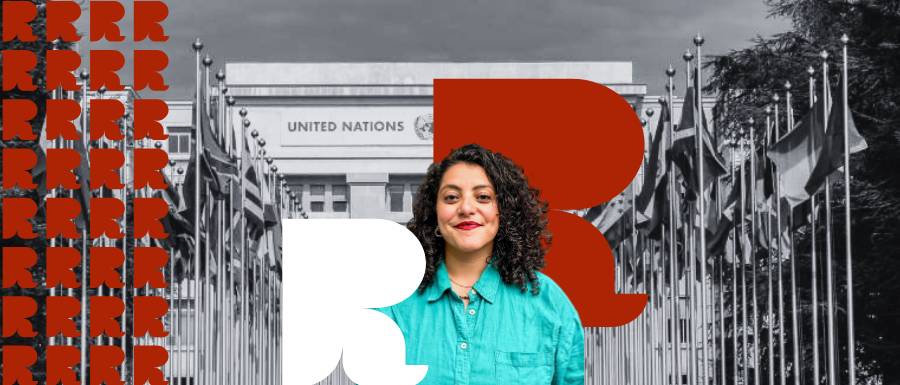
REDWORD for Human Rights and Freedom of Expression participated in the 18th session of the United Nations Forum on Minority Issues, held on November 27–28, 2025, at the Palais des Nations in Geneva. This year’s forum examined the role of minorities in fostering diverse, peaceful, and dynamic societies.
The organization was represented by Dr. Miray Philips, a member of REDWORD’s Board of Directors and an Assistant Professor of Sociology at the University of Toronto. In her intervention, Philips highlighted key challenges facing Copts in Egypt and in the diaspora, with particular emphasis on the authority of the Orthodox Church in managing Coptic affairs in alignment with state authority.
REDWORD also presented three recommendations, chief among them a call to revise the United Nations Declaration on the Rights of Minorities to better address intersectionality and to recognize marginalized groups within minority communities.
REDWORD’s Full Statement:
On behalf of REDWORD, and as a Coptic-Egyptian-American professor, I am here to address intersectional concerns by Copts in Egypt and the diaspora that serve as barriers to social inclusion. Copts are the largest ethno-religious minority group in Egypt, making up about 10-20% of the population.
Today, the Egyptian state governs the Coptic population through the leadership of the Coptic Orthodox Church. This positions the Church as the primary religious and political representative of all Copts. This dynamic maintains the authority of the Church, the interests of the state, reduces Coptic affairs to the question of religion, security and counterterrorism, and ultimately overshadows the complexity of Coptic lived experiences and concerns in Egypt and the diaspora.
Beyond well documented violations pertaining to religious freedom and freedom of expression, Copts at the intersection of other minoritized communities face compounded violations, sometimes from within the community itself.
Queer Copts are subjected to systemic campaigns of hate by the Church and state. The Church also supports the pseudoscientific practice of conversion therapy. Clergy advise Coptic women suffering from domestic violence to “carry the cross” rather than seek separation and protection. And the Church hierarchy has also mishandled several cases of clergy sexual violence.
The Church and state also work together in violating the rights of other religious minorities, such as atheists in Egypt. In 2025 alone, the state arrested 39 individuals who do not belong to officially recognized religions.
Since minority rights are individual, not group rights, effective inclusion of Copts entails going beyond Church representation and state tokenization. Rather, all Copts should be able to represent their own identities and concerns, including and beyond matters of religion.
We therefore recommend that:
- The Egyptian state uphold the values of citizenship and officially recognize minoritized communities in all their diverse forms and intersections.
- The state ensure the protection of all Copts and their political inclusion.
- We also call on the forum to revise the UN Declaration on Minorities to address intersectionality, to account for marginalized communities within minority communities.