Tunisia
In the streets of Tunis, they wait. Men from Guinea, Mali, and Sudan stand on street corners and roundabouts, their hands calloused from labour Tunisians increasingly refuse. One or two are chosen for a day’s work, hauling sacks of cement, carrying bricks, earning just enough for a meager meal.
Young women move quietly from door to door, ushered by “handlers,” men from their own communities who arrange work as babysitters or housemaids, taking half their wages in exchange for the promise of protection. Labour is parceled, sold, and discarded like merchandise.
Meanwhile, in 2023 European Union signs a €105 millions Memorandum of Understanding with Tunisia for “border security” and “migration management.” But not a cent is earmarked for labour protections. The EU measures success in fewer arrivals at its shores, blind to the reality that its policies have turned Tunisia into a trap.
By early 2025, this trap was visible across Tunisia. In the Amra area near Sfax, authorities dismantled camps sheltering nearly 20,000 migrants, burning tents, destroying a makeshift hospital, and forcing families into the wilderness. Weeks later, more than 3,400 others were repatriated under “voluntary return” programs framed as choice but carried out after raids and expulsions that left people little alternative.
Tunisia’s role as Europe’s gatekeeper
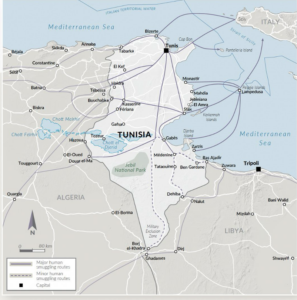
Human smuggling routes through Tunisia, January 2023
In 2023 and 2024, departures from Tunisia overtook those from Libya, making it the primary launchpad across the Central Mediterranean. According to UNHCR, 66,617 people arrived by sea in Europe in 2024, and 1,172 were reported dead or missing.
The EU’s July 2023 deal with Tunis promised money for the coastguard, resources to clamp down on smugglers, and control over migration “flows.” For a brief moment, Brussels boasted of fewer departures. But the smugglers adapted. Crackdowns in Sfax pushed them inland, to riskier coasts, with extortionate prices. A Reuters investigation revealed crossings to Sicily cost up to €6,000 per person; a 2025 leak by Inkyfada reported fees soaring to €10,900, organized over WhatsApp and paid in desperation.
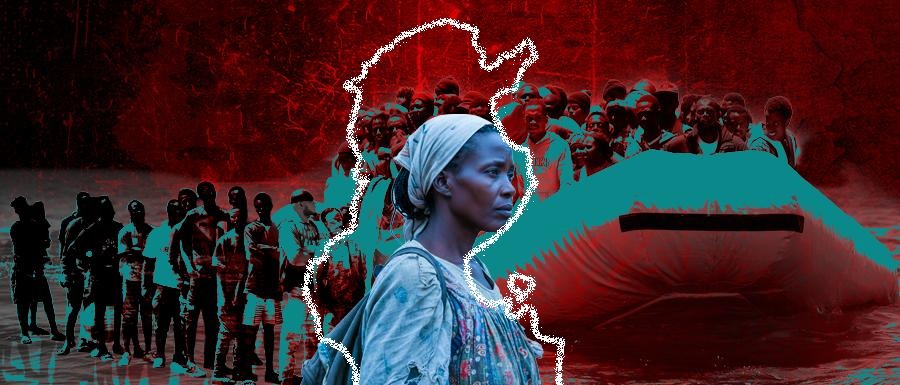
A woman fled Burkina Faso with her sister after jihadists overran their village, a stark reminder of how weak state control and persistent insurgencies can uproot ordinary families. They traveled together along an informal route run by smugglers, who promised safe passage to Tunisia. But the journey quickly turned perilous. Midway, the smugglers raised the price for the leg from Niger to Tunisia. Unable to pay, they, like many others on the route, fell into debt, and the sisters were separated. Her sister was left in Niger, effectively held hostage until the fees could be settled.
“I am stuck here in Tunis, still in debt to the smugglers who have my sister in Niger,” she said.
“The plan was for me to work here, earn enough to pay them, and for my sister to join me. But prices keep rising. EU-backed restrictions in Tunisia make it more expensive and dangerous. I am scared for both our safety.”
The squeeze also meant fewer boats overall: Tunisian authorities reported a sharp fall in crossings to Europe, from almost 98,000 people in 2023 to just 19,000 in 2024. But this apparent “success” came at the cost of people being stranded in informal camps around Sfax. In December 2025, two migrants died from carbon monoxide poisoning after lighting fires to stay warm in makeshift shelters. A stark reminder that containment does not equal protection.
The more Europe cracks down, the higher the cost of passage, and the more migrants remain trapped in Tunisia, consigned to a shadow economy.
The politics of scapegoating
In February 2023, President Kais Saied declared that sub‑Saharan migration was part of a plot to “replace” Tunisia’s Arab identity. Borrowed from Europe’s far right, dressed up in nationalist rhetoric, the effect was immediate: tenants evicted, Black Africans attacked in the streets. Hate became policy by another name.
But this was more than rhetoric. Saied’s tactic was political, diverting voter’s anger away from his government’s economic failures and crumbling social protections. By presenting migration as the root of Tunisia’s hardships, he shifted public frustration from unemployment, inflation, and debt onto the bodies of Black migrants
“I was waiting for a bus when a policeman stopped me and asked for my papers,” one woman told me. “I didn’t have them, so he took my handbag, searched it, and took all the money I had. I couldn’t even pay the rent for the two-bedroom apartment I share with six other women.”
Her story is not unique. Since 2023, Tunisian authorities have expelled migrants to deserts on the Libyan and Algerian borders, leaving them without water or shelter. Amnesty reports that between June-July 2023 alone, at least 28 migrants were found dead along the Libyan-Tunisian border, and 80 migrants were reported missing.
The consequences reached beyond Tunisia’s borders. Côte d’Ivoire and Burkina Faso temporarily recalled their ambassadors, accusing Tunis of systemic racism and “illegal deportations” that endangered lives. At a March 2024 meeting with the African Union, EU, and United Nations diplomats openly denounced Tunisia’s policies, sparking heated exchanges with Tunisian officials.
Europe looked away. Aid continued, and coastguards were trained in cooperation with the German Federal Police. Yet not all voices were silent.
“This is not Europe, these are not European values,” said EU Commissioner Nicolas Schmit, criticizing the Tunisia deal as “an agreement with a very special nasty dictatorship” and warning that refugees are effectively being fought, not protected. He called for the agreements to be revised, noting that “we do not know exactly how the money is used.”
Legal Voids: trapped between law and exploitation
In Tunisia, the law offers little refuge to those without papers. An undocumented migrant cannot access labor protections unless they first secure a residency or work permit. Under Article 258-2 of the Tunisian Labour Code, the only path is through employer sponsorship, tied to a one-year contract, renewable once.
For most, this is a distant hope. Undocumented workers toil long hours, often side by side with Tunisian colleagues, yet receive far less pay, sometimes weeks late, sometimes withheld entirely. Carrying sacks of cement in the blazing sun, mopping floors, or scrubbing kitchens, only to receive a fraction of the promised wage, and sometimes nothing at all.
Racism amplifies their vulnerability. Migrants report being mocked, scolded, or dismissed by employers or co-workers. One worker from Camerone said:
“I work harder than the local men, but they are paid double. Sometimes I wait two weeks for the money I earned yesterday. If I complain, I am told to leave.”
The system thrives on this uncertainty. Workers remain disposable, exploited in plain sight.
By 2025, civil society’s capacity to intervene had also shrunk. Tunisian authorities cracked down on NGOs offering humanitarian support, raiding offices and detaining staff. The repression deepened migrant’s vulnerability, with fewer organizations able to monitor abuses or provide legal aid, undocumented workers had even less recourse when wages were stolen or when exploitation turned violent.
The European Union could have used its leverage to defend migrant rights instead of merely counting arrivals at the shore. By tying funding to legal reforms, the EU could have pushed Tunisia to make work permits more accessible and to enforce protections against exploitation. Countries like Italy and Portugal provide models, in Italy, victims of severe exploitation can obtain a and cooperate with authorities without fear of deportation. In Portugal, undocumented migrants can report abuse and claim unpaid wages through the . Access to minimum wage, occupational safety, and legal aid shows how governments can actively protect migrant workers’ dignity.
The shadow network: women exploited in plain sight
In Tunis, exploitation is not hidden, it walks openly beside you. Young women from sub-Saharan Africa are escorted by “handlers”, men from their own communities who decide where they will work, when, and for how much. The handlers present themselves as protectors, but their power is built on fear and dependency. They take half of the women’s earnings, sometimes more, threatening to cut them off from work entirely if they resist.
One woman recounted:
“He takes us to houses. He decides who will hire us, and I get only half of what I earn. I cannot complain, and if I leave, I have nowhere to go.”
For many, the psychological weight is unbearable. Women describe waking each day with no certainty of work, knowing they are trapped between the risk of destitution and the coercion of the handler. They speak of sleepless nights, anxiety, and depression. The constant fear of police raids or sudden eviction layered atop the humiliation of being treated as commodities in a market that thrives on invisibility.
Tunisia has ratified a series of international treaties that obligate it to prevent exploitation and protect workers’ rights, including the International Covenant on Civil and Political Rights (ICCPR), the Convention on the Elimination of All Forms of Discrimination Against Women (CEDAW), and ILO conventions on forced labor and decent work. These commitments legally require Tunisia to ensure fair treatment, protect against abuse, and safeguard dignity. Yet in Tunisia, these obligations remain hollow words, contradicted daily by the lived reality of women under the control of handlers.
Many of these experiences match documented patterns among Ivorian domestic workers in Tunisia. Women are recruited in Côte d’Ivoire under promises of well-paying domestic jobs, only to find their passports confiscated, their recruitment costs imposed as debts, and months of forced work without pay. In some cases, workers are expected to work 4-6 months for free just to repay travel or agent fees.
Ivorian nationals make up a disproportionate share of trafficking victims in Tunisia: for example, in 2023, among the foreign victims of labor trafficking, many were Ivoirians, and female Ivorian domestic workers are heavily represented in assessments of forced domestic servitude across Tunis, Sfax, Sousse, and Gabès.
Tunisia’s streets are not just a local crisis; they reflect Europe’s misaligned priorities. By outsourcing border control without accountability, the EU has created a zone where exploitation thrives, and migrants are treated as collateral. Smugglers adapt, debt piles up, and human suffering is invisible to policymakers focused on statistics.
Rather than funding more coastguard boats or checkpoints in Tunisia, European resources should be redirected to anti-trafficking forces and programs, and to strengthening the security and stability of Sub-Saharan countries where migration begins. Building governance, economic opportunity, and rule of law at the source tackles the root causes, instead of leaving people trapped in peril halfway across the continent. Without this strategic pivot, Europe will continue to externalize both risk and responsibility, while the most vulnerable bear the cost.