
The conflict in Sudan’s Darfur region in the southwest began in 2003, when two rebel groups—the Sudan Liberation Movement (SLM) and the Justice and Equality Movement (JEM)—launched an armed rebellion against the central government in Khartoum. They accused the government of marginalizing the region and discriminating against residents of African descent. In response, the government carried out a campaign of ethnic cleansing targeting African communities in Darfur, killing hundreds of thousands of Sudanese. Because of these actions, Sudan’s former president, Omar Al-Bashir—who ruled from 1989 until he was overthrown by the 2019 revolution—was classified as a war criminal. The International Criminal Court issued a warrant for his arrest, accusing him of war crimes and genocide in Darfur.
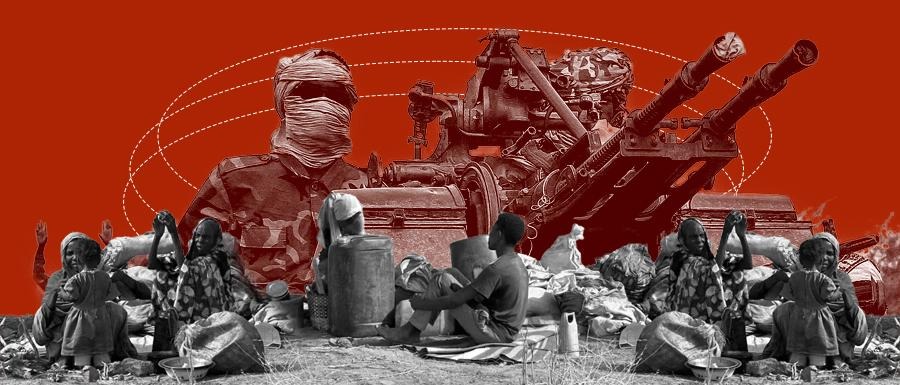
The Rapid Support Forces (RSF), also known as the Janjaweed, were created with Bashir’s backing to fight the rebel groups in Darfur. Although the Sudanese government denied this, the militia was in fact supported with funding and weapons and operated alongside police and army units in Darfur, including in the city of Al-Fashir, capital of North Darfur. Today, Al-Fashir suffers from the presence of RSF militias implicated in committing genocide and ethnic cleansing.
Because the militias have operated in the region for so long, they now possess deep knowledge of the state and how to dominate it—especially as the Sudanese army has retreated and continues to exhibit racist attitudes toward the region’s population, leading to its severe neglect.
The siege of Al-Fashir in Darfur began on May 10, 2024, when RSF forces surrounded the city, accusing armed movements of supporting the army and violating their pledge not to participate in the war. The RSF imposed a suffocating blockade on the city, closing roads and preventing the arrival of goods and humanitarian aid, creating a catastrophic humanitarian crisis and severe shortages of food, medicine, and fuel.
The head of the Sudan Liberation Movement and governor of Darfur, Minni Arko Minnawi, stated on X: “The fall of Al-Fashir does not mean surrendering Darfur’s future to violent groups or the interests of corruption and treason.”
Dr. Tasneem Al-Amin, spokesperson for the Sudanese Doctors Network, said in a statement on the Network’s Facebook page that the massacres the world is witnessing today are a continuation of what has been happening in Al-Fashir for more than a year and a half—killings through shelling, starvation, and physical liquidation targeting more than 14,000 civilians under a total siege, systematic starvation, and deliberate attacks on civilian facilities, markets, and displacement camps. Yet in just three days, RSF militias killed nearly 2,000 civilians in Al-Fashir—most of them executed as they tried to flee the city while clashes reached their peak.
What is happening in Al-Fashir is a true genocide based on ethnicity amid international and regional indifference, without any reaction proportionate to the scale of massacres committed against civilians—massacres that the perpetrators broadcast openly, in a clear challenge and deliberate, systematic intent to kill innocent civilians.
UNICEF Executive Director Catherine Russell warned last October that an estimated 130,000 children in Al-Fashir are at risk of severe rights violations amid reports of kidnapping, killing, mutilation, and sexual violence. Russell stressed that “no child is safe” in the capital of North Darfur. The World Health Organization also expressed deep horror and shock at reports of the brutal killing of more than 460 patients and their companions at the Saudi Maternity Hospital in Al-Fashir, following attacks on and abductions of healthcare workers.
Meanwhile, the Emergency Room in the town of Tawila in North Darfur announced that the number of displaced people in the area had reached one million from various parts of the region since the start of the war. It added that this influx has placed enormous pressure on resources and created a dire humanitarian situation. It issued an urgent humanitarian appeal to the international community to provide aid and urged national and international organizations to offer direct support to meet the immediate needs of the displaced. The Preliminary Committee of the Sudanese Doctors Syndicate said that 177,000 civilians remain trapped in Al-Fashir by RSF forces, and it is believed that many of them have been subjected to mass killings.
The committee added that 28,000 people were displaced in just 48 hours amid attacks targeting escape routes, while more than a thousand displaced people reached Tawila suffering from injuries, hunger, and dehydration.
Darfur is one of Sudan’s richest regions in natural resources. It holds extensive mineral wealth—including gold, copper, gemstones, iron, uranium, mica, gypsum, and marble. Its fertile lands contain groundwater and natural lakes, in addition to vast livestock resources. The region also has oil deposits, making it one of Sudan’s most valuable areas.
Because of these resources, the region has become a battleground for competing armed groups and militias, as well as for foreign governments and entities that support armed factions aligned with their interests. Meanwhile, civilians continue to suffer from systematic ethnic cleansing and genocide, as the world remains largely silent and media coverage remains limited.
**The opinions expressed in this article represent the author’s views and do not necessarily reflect the positions of REDWORD.