

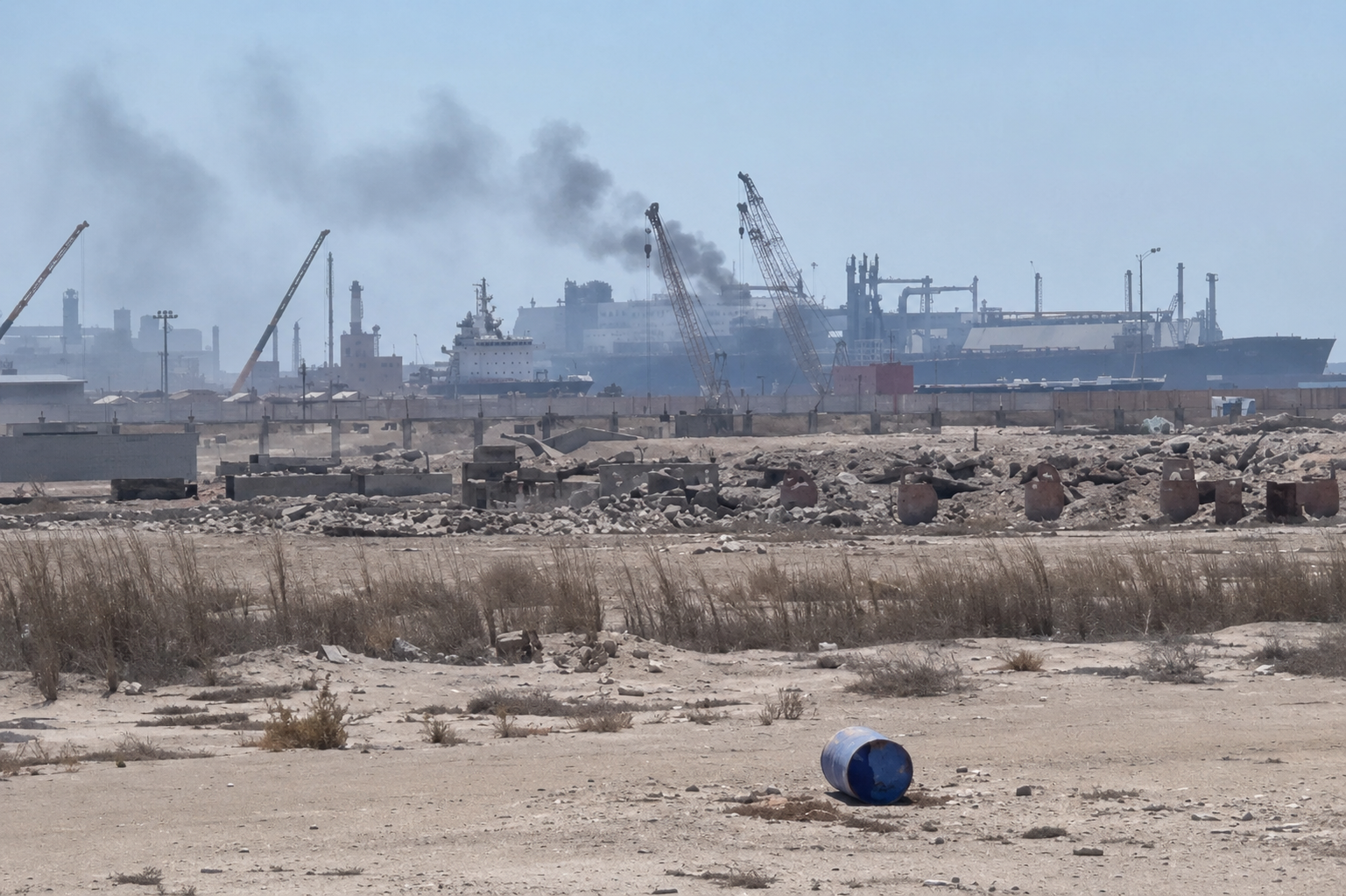
On July 29, 2026, a fire broke out at Egypt’s Damietta Port on the Mediterranean coast after a drone reportedly struck a gas vessel owned by a U.S. company. No group or state has claimed responsibility for the incident. Egyptian authorities, meanwhile, have released few details and have not publicly disclosed the findings of the investigation, leaving unanswered questions over who was behind the strike and what motivated it.
The lack of official information has fueled speculation over the identity of the perpetrator and raised broader questions about Egypt’s position in the region’s ongoing conflict, including the risk of a wider escalation and the possibility that Cairo could be drawn into a direct confrontation with one of the parties involved.
On May 2026, Egyptian President Abdel Fattah el-Sisi met with Mohamed bin Zayed Al Nahyan to discuss regional developments, according to the Emirates News Agency (WAM). During Sisi’s visit to Abu Dhabi, it was announced that Egyptian fighter jets were stationed on UAE.
Sisi condemned the Iranian attacks on the UAE, declaring that “What Affects the UAE Affects Egypt,” without providing any details about the Egyptian fighter jets, their number, their role in the current war, the missions assigned to them, or the number of Egyptian military personnel currently present in the UAE.
The deployment of Egyptian fighter jets in the UAE for the first time raises important questions about Egypt’s position in the current conflict. If tensions escalate again and Iran launches attacks on the UAE, could Egypt be pulled into the war? Could the Egyptian military find itself end up fighting alongside Israel against Iran? And would the Egyptian army even accept participation in such a war?
Could the strike on Damietta Port, then, be interpreted as a preemptive warning from one of the parties to the conflict—a signal intended to deter Egypt from becoming more deeply involved?
It not only controversial from a constitutional perspective — since the Egyptian constitution imposes strict restrictions on deploying armed forces outside the country’s borders, requiring consultation with the National Defense Council and approval by a two-thirds majority in parliament — but it is also a risky and potentially reckless move. Rather than containing tensions, it could contribute to further escalation and expose Egypt and the wider region to serious security and economic consequences.
Historically, relations between Egypt and Israel have remained tense. Although the two countries signed a peace treaty more than four decades ago, it has largely functioned as a strategic military arrangement designed to avoid escalation, while continuing to face widespread rejection among the Egyptian public.
During the Gulf War (Operation Desert Storm), for example, Egypt agreed to participate in the U.S-led coalition to liberate Kuwait from Iraqi invasion only on the condition that Israeli forces would not take part.
Official Egyptian-Israeli relations have worsened since the war in Gaza, particularly after Israel accused Egypt before the International Court of Justice of obstructing humanitarian aid deliveries through the Rafah crossing. These accusations came during the genocide case filed by South Africa against Israel over alleged crimes against Palestinians in Gaza, prompting Egypt to threaten joining South Africa’s case before later retreating from that position.
At the same time, both countries exchanged accusations of violating the Egyptian-Israeli peace treaty, especially after Israel took control of the Philadelphi Corridor along the border between Egypt’s Sinai Peninsula and the Gaza Strip — a move many analysts viewd as a breach of the agreement.
Relations between Egypt and the United States have also faced strain, particularly after Egypt rejected Donald Trump’s proposal to resettle Palestinians in Sinai. However, the recent escalation involving Israel and the United States in the war with Iran has placed Egypt in a an uncomfortable position with the Gulf states.
The United States used military bases located in Gulf countries to launch strikes on Iran, while Iran retaliated by targeting seven Arab countries, including Saudi Arabia, the UAE, and Bahrain.
Because of Egypt’s official stance of non-involvement in the war, tensions have grown between Cairo and Gulf governments seeking Egyptian military protection and support in return for economic assistance. This dynamic reflected in comments by some Gulf journalists and influencers who openly criticized Egypt and demanded Egyptian military backing.
Yet the regional map is far more complicated than that.
Relations between Saudi Arabia and the UAE, for instance, are far from ideal. Their disagreements became visible with the UAE’s withdrawal from OPEC, and earlier through tensions in Yemen, where the UAE supported separatist groups — a policy Saudi Arabia viewed as threatening its national security.
Meanwhile, relations between Egypt and the UAE have also experienced repeated tensions over issues tied to Egyptian national security. One example is Emirati investments in Ethiopia, which some critics view as indirect support for the Grand Ethiopian Renaissance Dam (GERD), a project Egypt considers harmful to its share of Nile water resources.
The UAE has additionally faced accusations of financing and supporting the Rapid Support Forces (RSF), led by Mohamed Hamdan Dagalo in Sudan. The RSF has been accused of ethnic cleansing in Darfur, while Egypt backs the Sudanese army out of concern for security along its southern border.
Many Egyptian opposition figures argue that Saudi Arabia and the UAE have increasingly become a threat to Egyptian sovereignty through their interventions in sensitive regional issues in ways that conflict with Egypt’s own strategic interests. They also accuse Gulf countries of burdening Egypt with debt and influencing domestic affairs through massive investments and land acquisitions — including the transfer of the Red Sea islands of Tiran and Sanafir to Saudi Arabia in 2016, despite an Egyptian administrative court ruling affirming the islands’ Egyptian sovereignty. The sale sparked public protests that were suppressed by security forces, with dozens arrested.
Critics also point to Emirati investment projects aimed at acquiring Egyptian land at extremely low prices and deepening economic influence inside the country, such as the Ras El Hekma development project on Egypt’s northwestern Mediterranean coast.
Relations between Egypt and the Gulf states have grown significantly closer since the 2013 military coup, with Saudi Arabia and the UAE providing substantial financial and political support to the new regime and helping stabilize the economy. Over time, however, Egypt’s economy deteriorated under the weight of debt and loans, with Arab countries now accounting for nearly 35% of Egypt’s external debt, according to a report by the Egyptian Initiative for Personal Rights.
Within this tangled regional landscape, could the Egyptian army really fight alongside Israel? Or fight as a proxy on behalf of Gulf countries if tensions escalate again?
I do not believe that scenario is likely, despite the serious implications of deploying Egyptian air forces in the UAE without transparency regarding their role.
In my view, Egypt’s involvement would most likely remain limited to defensive measures and protection in the event of Iranian attacks on the UAE. I do not believe the current Egyptian regime would risk being drawn into the war simply to gain Gulf favor — especially if doing so would effectively place Egypt alongside American-Israeli military operations against Iran.
At most, Egypt’s role would be defensive, if it were forced into such a position.