
Case study: Egypt & Tunisia
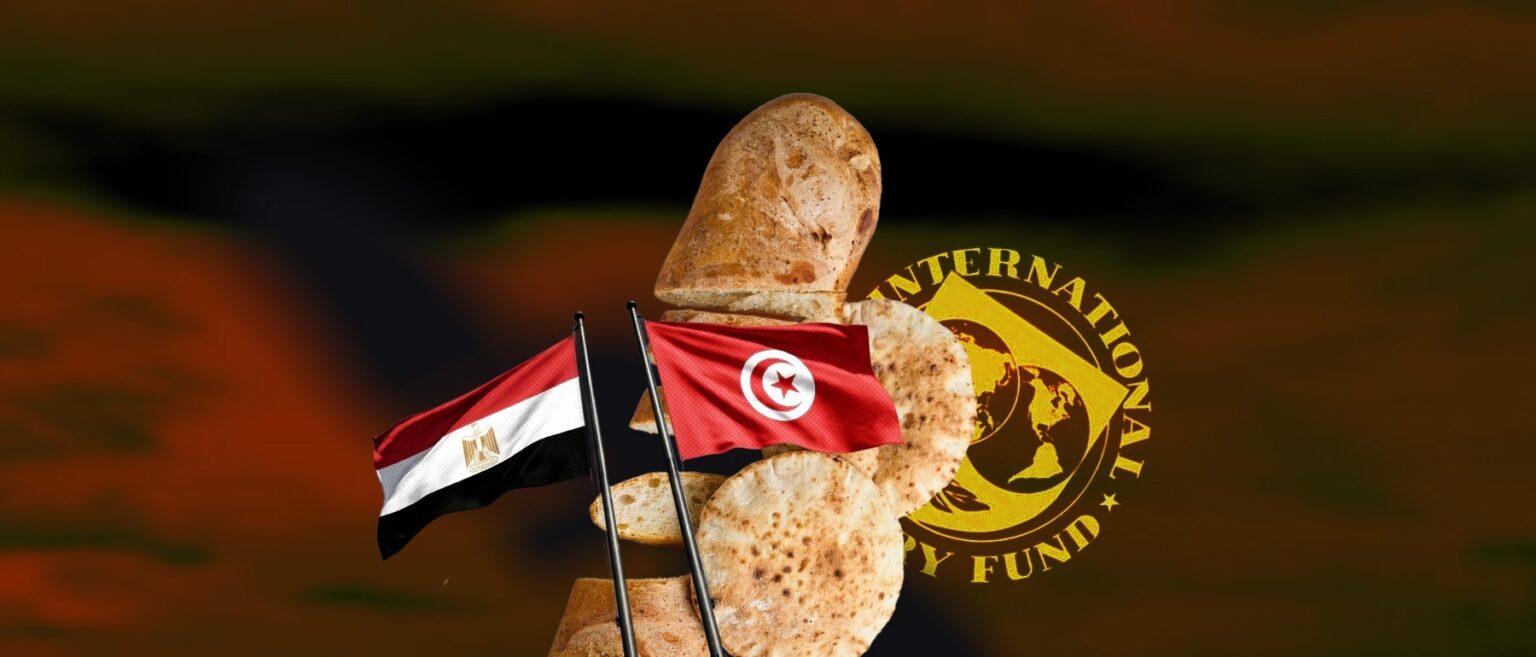
In April 2023, Tunisian President Kais Saied said no to a $1.9 billion IMF loan, the same demand to cut bread and fuel subsidies that had already killed people twice in this country’s history. “Foreign diktats,” he called them. Three years later, the loan is still dead, and nobody knows if refusing was courage or delay.
Nine hundred kilometers east, Egypt chose quiet: a smaller loaf, cheaper flour blended in, sixty million names dropped from the ration rolls. No riot, no headline, just less, for people who already had little.
Both are unresolved, the latest chapter of something that didn’t start with the IMF. To understand why refusing a loan now echoes a colonial subject, and why a ration card can vanish without the riot one caused in 1977, go back to the first time someone decided what these countries would grow, and for whom.
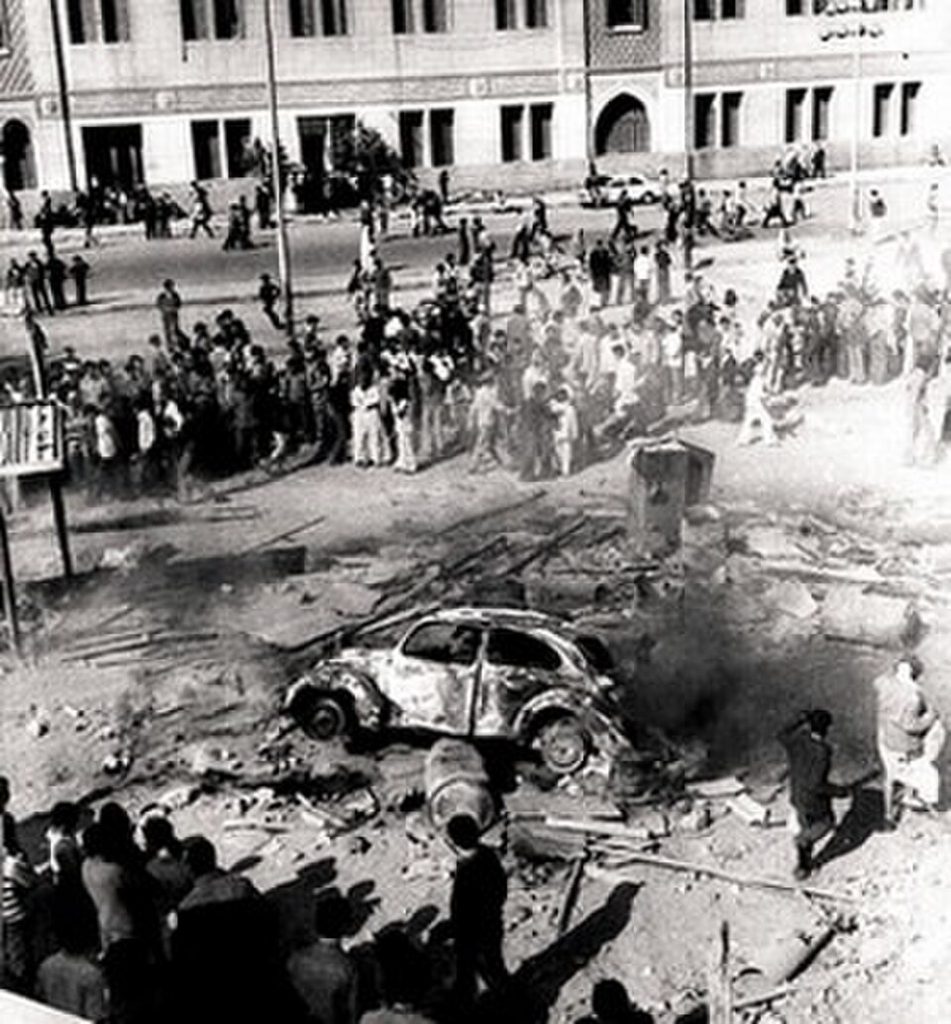
On the night of January 17, 1977, Egypt raised bread, sugar, and cooking oil prices by decree, no parliamentary vote. By morning, five thousand workers at the Alexandria naval arsenal read the new prices and walked out. Within a day it was the largest uprising since 1952.
By the time the army restored what officials called order, roughly 80 were dead, over a thousand arrested. Sadat’s regime blamed communist agitators rather than admit hunger had done this. Almost nobody believed it, including, privately, the officials who said it.
Weeks later, Saudi Arabia, Kuwait, Qatar, and the UAE handed Cairo more than $2 billion in emergency funds and deposits. The same pressure that forced the cut paid for the retreat from it. Cairo was never being fed. It was being managed.
The man who said the quiet part out loud
In 1974, US Secretary of Agriculture Earl Butz told a reporter he’d flown to Cairo “with a little wheat in my pocket… I was speaking the language of food, and they understand.” That wheat had a name, PL-480, Food for Peace; between 1959 and 1960 it jumped from a quarter of Egypt’s grain imports to two-thirds. A 1987 MERIP analysis named its purpose: commercial and political.
Egypt is now the largest wheat importer on earth, unable to grow six of every ten loaves it needs. Its 2016 $12 billion IMF loan named “over-reliance on food imports” as a crisis to solve. Then it raised VAT to 13 percent. It cut the top tax bracket from 25 to 22.5 percent.
Nobody at the USDA or the IMF answered for any of it. In June 2024, Egypt raised the baladi bread price for the first time in over thirty years. Every subsidy cut since has been called a political failure of nerve.
The shock that wasn’t just politics
It was never only nerve. In summer 2010, Russia lived through a heatwave climate scientists Stefan Rahmstorf and Dim Coumou later calculated was, with roughly 80 percent probability, linked to climate change. The drought destroyed close to a third of that year’s wheat harvest. Russia banned wheat exports; global prices roughly doubled by February 2011.
Egypt, only 60 percent self-sufficient and reliant on Russia for half its imports, felt it immediately, paying roughly $280 a tonne instead of $183. Shenggen Fan, then director-general of IFPRI, called the spike “definitely, one of the causes of the Arab Spring,” the same uprisings that unseated governments in both Tunisia and Egypt within months.
Climate shocks like 2010 are only getting more frequent. A food-sovereign country can absorb one without it becoming a body count. Egypt and Tunisia could not, and the reason is everything that follows: a colonial land policy that decided what their soil would grow long before anyone had heard of climate change.
The cycle didn’t start with the IMF
None of it started with a lender’s checkbook. The machinery the IMF and Butz’s State Department later reactivated was built by an occupying power for a different purpose first, nearly a century earlier.
When Britain occupied Egypt in 1882, it restructured irrigation, taxation, and land under Lord Cromer to expand cotton for Lancashire’s mills. In 1870, cotton was 75 percent of Egypt’s exports; by 1910-1914, under full British control, 93 percent. Egyptian soil grew a crop nobody in Egypt could eat, so a British industry never ran short. Food self-sufficiency was never the point. Export volume was.
Corvée, forced peasant conscription into the fields and the Suez Canal, paid for that export figure. Britain declared its opposition to forced labor a principle in 1882, then postponed abolishing corvée until Egypt’s cotton-servicing debts were paid. The principle waited for the balance sheet.
Tunisia’s version ran the same script, France holding the pen. After the 1881 protectorate, settlers arrived by the tens of thousands, eventually approaching a quarter million, and took the most fertile ground in the north, the Majardah valley and Sharik peninsula. Tunisian farmers who’d worked those fields for generations were displaced or reduced to laborers on land their families had owned.
Habib Ayeb, the Tunisian geographer who has studied food sovereignty across both countries, argues the postcolonial institutions that followed were never neutral either. He’s called organizations like Monsanto, USAID, and European development agencies not partners but targets, bodies that “try to impose their models on the Global South.”
Cotton and wheat were dismantled at independence, then rebuilt by other means. Tunisia’s salt marshes were never dismantled. The first French saltworks at Khniss dates to 1903. In 1949, France’s own Resident General in Tunis approved a convention merging five French salt companies into COTUSAL. The 1949 signature is still the legal basis some concessions operate under today.
In nearly sixty years, that convention was amended three times, twice to expand COTUSAL’s land, once to shrink it. Workers protested in 2011, the wave that toppled Ben Ali. Chahed terminated two concessions, at Sfax and Sousse, only in 2019, a decision that could have come in 2004. COTUSAL still operates at Zarzis and Mghira today. Tunisia ended the colonial paperwork before it ended the colonial company.
Neither country won independence into a blank slate. The map was already redrawn for someone else’s benefit, generations before anyone sat down with the IMF. Bourguiba didn’t invent Tunisian land serving a foreign market; he inherited it, and swapped baguettes for the settler’s wheat fields. Postcolonial and colonial dependency are the same story.
A different empire, the same loaf
Rome once called Tunisia its breadbasket, and earned it: two thousand years of couscous, barley bread, bsissa, food that asked nothing but a good harvest. Two thousand years of harvest never once put a body in the street. A loaf with no history in the country did, in 1983.
After France left in 1956, Bourguiba built the new social contract on a subsidy for imported soft wheat, baguette flour with zero Tunisian history. By the early 1980s it cost $143 million a year, a quarter of the deficit, and the IMF wanted it gone. On December 29, 1983, the government pulled it. Prices doubled overnight. Riots reached every major city. Between 100 and 150 died. Bourguiba reversed it on television a week later.
It was a colonial habit the state kept the way it kept the colonizer’s court system. Tunisia imports 95 percent of its soft wheat. Ukraine’s war cut supply in 2022; Tunisia spent an extra $250 million and took a $130 million World Bank loan just to keep bakeries running.
The oil flows out while the wheat flows in
Tunisia’s story is sharper than Egypt’s, and crueler. It wasn’t drained of food, it was made to trade its best food for the West’s leftovers, on paper, in a signed agreement, in public.
Under the 1995 EU-Tunisia Association Agreement, policy reoriented around one line: grow more olive oil for export, and use the currency it earns to buy grain. Ninety percent leaves for Europe, mostly unmarked bulk at a locked-in €1.85 a liter, later rebottled as Italian or Spanish. Sarah Ben Romdane, who founded a brand selling direct, said flatly: these are the patterns of past colonies.
So little oil is left at home that domestic prices jumped 80 percent in seven months in 2023, from 15 to 25 dinars a kilogram. Tunisians increasingly can’t afford the oil their own soil grows. They send it to Rome and Madrid, and bring white flour back. Nobody needs a metaphor for that trade.
When the European Parliament floated, in 2016, a slightly larger duty-free quota for two years, Italian farmers pushed back hard enough that Italy’s own Agriculture Minister opposed it publicly. A country whose oil quietly fills European shelves couldn’t get more of it across the border without Europe complaining.
It was never only the wheat
The same colonial logic that engineered grain dependency also opened the door, quietly, to a harm that never had to be engineered at all. The wheat was a policy. The sugar is just a market nobody bothered to regulate, and it arrives in a bottle, or a tin of baby cereal, with nobody rioting over either.
Egypt now has the highest obesity rate in Africa; its soft drink market grew 27 percent from 2015 to 2019 and keeps climbing since. Coca-Cola’s own pricing strategy leans on affordability, pricing sugar drinks to local income, a pattern researchers have found across dozens of low- and middle-income markets. In 2022 it sponsored Egypt’s COP27; researchers noted it was already sponsoring the country’s obesity crisis before it sponsored a summit meant to address global harm.
Nestlé has manufactured in Egypt since 1988, making everything from Nescafé to Cerelac to Pure Life water. A peer-reviewed investigation found Nestlé’s baby food line, Cerelac included, carries added sugar in Africa that the identical Swiss product doesn’t. A six-month-old in Cairo gets a sweeter formula than one in Geneva, same company, same brand. No regulator on either continent has required a reformulation.
What this story leaves out
A fair account admits two things this piece could skip, because they complicate a tidy Western-villain story.
First, Egypt’s newest threat to its water and wheat is not Western. Roughly 85 percent of the Nile’s water originates in Ethiopia; Egypt depends on it for 95 percent of its freshwater. Ethiopia’s Grand Ethiopian Renaissance Dam, fully operational since September 2025, is treated in Cairo as existential, though a 2025 modeling study found no meaningful reduction in Egypt’s targeted water release across the large majority of simulated years. A genuine risk, and proof not every threat here runs through London or Washington. This one runs through Addis Ababa.
Second, domestic power in Egypt made its own choices, unrelated to any lender. Its military, through an Air Force body called Mustaqbal Misr, took exclusive authority to contract Egypt’s wheat imports from the civilian authority that held it for decades. Per Carnegie Endowment research: no audits. No oversight. Its revenue never touches the state budget it’s supposed to serve. Cairo wrote that, not Brussels.
Neither fact erases the colonial policy already documented, or the IMF conditionality that followed it. The map was drawn by outsiders first, and is now partly redrawn by insiders who answer to no one either.
Two answers to the same question
In April 2023, one government finally said no: Saied rejected the loan, calling its conditions “foreign diktats” that would “lead to more poverty.” Three years on it’s still dead, debt past 80 percent of GDP, and nobody is sure whether refusing was principle or delay, from a president who spent those years jailing his opposition.
Egypt chose the quieter option: a smaller loaf, sixty million cut off the ration rolls, then a price hike anyway in 2024, the first in 36 years. Mohamed El-Gezawy, who works a subsidized bakery in Giza, still serves 500 to 700 customers daily; the loaf now weighs about 90 grams, down from roughly 140. No riot, no explanation owed.
Fifty years apart, Cairo and Tunis still answer for a colonial map drawn by people long dead, to an institution that has never had to explain itself to anyone.
None of this needed a leak. Butz said his quote proudly. The IMF’s conditions sit in its own loan documents. The EU-Tunisia agreement is public law. Nestlé’s formulation gap was found by comparing its own labels. Nobody broke into a filing cabinet. Somebody just looked, and asked who it helped.
No IMF official has answered for a clause a peer-reviewed study credits with triggering food riots across Egypt, Jordan, and Tunisia for two decades. Nobody in London or Paris answered for what came a century earlier: cotton fields, settler wheat farms, a salt concession still partly running under the same French name today. A colonial habit outlived colonialism, breathing first through an occupier’s land policy, then a lender’s conditions, now a domestic institution that learned its occupiers’ own lesson.