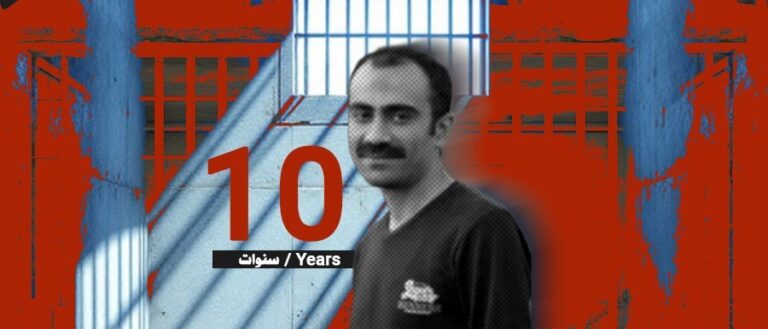


Egyptian authorities are carrying out a security campaign targeting the Shia minority in Egypt, coinciding with the commemoration of Karbala, one of the holiest occasions for Shia Muslims and a period of mourning for the martyrdom of Imam Hussein. Security forces have arrested several members of the Shia community from their homes and other locations. They have also arrested Haidar Qandil, a journalist at Dostor newspaper, who remains forcibly disappeared.
According to a post published by Qandil’s brother on Facebook, at noon on Monday, June 22, forces from the National Security Sector raided the home of Qandil’s brother-in-law, destroyed the contents of the apartment, arrested him, and took him to an unknown location. Later that same evening, security forces arrested Qandil outside his workplace at Dostor newspaper and took him to an unknown location, alongside other members of Egypt’s Shia community.
This is not the first time Qandil has been arrested because of his religious identity or his journalistic work, which focuses on the rights of Egypt’s Shia minority. In December 2019, Qandil was arrested and subjected to enforced disappearance for three months, during which he was physically assaulted and tortured, according to documentation by local human rights organizations. He later faced charges including contempt of religion, promoting Shiism, and establishing an unlawful group.
After his release in August 2020, Qandil was subjected to weekly police monitoring. He was also arbitrarily banned from travel without a judicial order. In December 2021, after he had already received an exit stamp to leave Egypt, a passport officer stopped him and instructed him to report to the National Security headquarters to request permission to travel. The officer also informed him that there were instructions to confiscate his passport and prevent him from leaving the country.
According to Al-Araby Al-Jadeed, a National Security officer told Qandil that he would not be allowed to work in journalism again. Shortly afterward, an official at the newspaper where he was working at the time informed him that he had been dismissed pursuant to security instructions. He was also prevented from collecting his personal belongings from the workplace.
This security campaign forms part of a broader pattern of restrictions imposed on Egypt’s Shia minority. The Ministry of Endowments announced the closure of the Imam Hussein shrine for “maintenance” from 9 to 11 Muharram, according to the Islamic Hijri calendar, coinciding with the anniversary of Ashura.
Shia sources in Egypt confirmed that this practice takes place every year to prevent members of the community from practicing their religious rituals and visiting the Imam Hussein shrine during the commemoration of Karbala on the tenth of Muharram. According to witnesses from Egypt’s Shia community, no maintenance is actually being carried out at the shrine; rather, “maintenance” is used as a pretext by the authorities to close the site every year during Ashura.
Religious minorities in Egypt generally face legal challenges and systematic marginalization. These challenges can prevent them from obtaining legal recognition, practicing their religious rituals, or freely expressing their religious identities and beliefs. Many fear state repression, social exclusion, incitement, and, in some cases, violence and targeted attacks.
Egypt is home to religious diversity and includes several religious minorities and communities. Among the most prominent are Copts, the country’s largest religious minority, as well as Jews, Baha’is, and Shia Muslims.
The current month of Muharram holds particular religious significance for Shia Muslims. The tenth day of the month, Ashura, marks the martyrdom of Imam Hussein, one of the most revered figures in Shia Islam.
There is no official census of the number of Shia Muslims in Egypt, a fact that underscores the depth of the crisis and the lack of transparency surrounding official figures. Estimates vary widely depending on the source, ranging from a few thousand to several million.
Although Egypt’s amended 2019 Constitution guarantees freedom of belief for all, it restricts the practice of religious rituals to the three Abrahamic religions recognized by the state: Islam, Christianity, and Judaism.
While Shia Islam is a branch of Islam, it differs from the orientation of Egypt’s Sunni-majority state. As a result, Shia Muslims face restrictions on their freedom to practice religious rituals, receive social recognition, and obtain protection from incitement.
REDWORD condemns the targeting of Egypt’s Shia community and the arrest of journalist Haidar Qandil. It holds the Egyptian authorities responsible for their personal safety and calls to:
- Disclose the place of detention of journalist Haidar Qandil and allow him to communicate with his family and lawyer.
- Immediately release Haidar Qandil and all members of the Shia community who have been arrested.
- Uphold the principle of equal citizenship, enable members of the Shia community to practice the rituals guaranteed to them by the Constitution, and protect them from any potential acts of violence.
- End the targeting of journalists and stop targeting individuals on the basis of their religious identities.