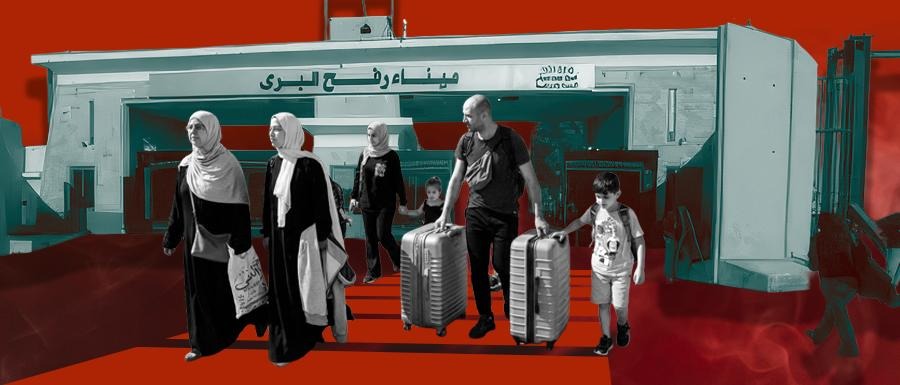
When the night settles and its noise fades, and Ghada sits by her window watching Cairo’s lights, she recalls the defining moment between homeland and exile. In October 2023, as the bombardment intensified and Gaza was transformed into an inferno, Ghada was confronted with an inescapable decision: fleeing a merciless war of genocide.
At the time, she was with her husband Khalil and their two children—Ammar, fourteen, and Sara, not yet nine. Fear was written across their young faces, alongside questions that had no answers. In February 2024, the family escaped Gaza for Egypt. Ghada carried her children and fragments of memory, leaving behind everything a lifetime had built—security, familiarity, and home. With no extended family or social support to lean on, they faced exile alone: a mother, a father, and two children navigating an uncertain future.
Ghada’s experience is one story among more than one hundred thousand Palestinians now living in Egypt. Each carries a distinct narrative of loss and perseverance, and of an exhausting struggle to secure a dignified life amid a lack of legal recognition and an unbroken will to endure.
A Home That Cannot Be Replaced: From Uprooting to Exile
“No home can ever truly replace the home—the social system, the relationships, the memories, the routines.” Ghada uses these words to describe the pain of being torn from her house. Home was never just walls and a roof; it was a full social world of safety, family, and shared history.
As airstrikes and warnings spread across Gaza, Ghada and her family were forced to move repeatedly—from one house to another, then from Gaza City to Khan Younis, and eventually to Rafah—always searching for a place that might offer even a little safety.
With the escalation of violence, she was compelled to leave entirely.
“On October 13, we were forced to leave our home under overwhelming grief and heartbreak.”
Each displacement marked a new chapter of suffering. Every time, she had to rebuild the basics: food, water, and shelter. With every move, the sense of fragmentation deepened. As she left her parents’ home, she reflected, “My mother is like a planted tree.. how can you uproot her from the ground?”
Leaving that refuge, and the separation of family members, was particularly painful.
“I watched everyone while searching for yet another place. Everything felt like a new form of scattering.”
Fear of bombardment merged with the struggle to protect her children from hunger and terror. Eventually, options vanished. One day, Ghada, her husband, and their children found themselves parked on the roadside, having exhausted every relative’s home. All had become displaced. Unexpected kindness intervened: local residents offered warm tea, and the family spent the night outdoors.
Ghada remembers “Umm Mahmoud,” who took responsibility for helping them. She persuaded her son to empty a room and welcomed the family in. The rent was symbolic—barely enough for two days’ food—but to Ghada, it meant shelter and safety.
In Rafah, inside that modest room, their internal displacement ended. Rafah—promoted by the occupying forces as a “safe zone”—became their final stop under siege and war. Umm Mahmoud was the saving presence that preserved what remained of their lives.
Then, before dawn one morning, as Ghada was writing in her notebook about the lost home—“What if the house returned? What if we returned?”—reality interrupted. A massive explosion shattered every window of the single-room dwelling. The fragile sense of safety collapsed. Khalil rushed the family downstairs amid dust and broken glass. For two hours, shelling thundered relentlessly, shaking walls and memories alike.
After that night, the family chose survival and decided to flee to Egypt.
Rafah Crossing: Paying to Survive
At a critical moment, Ghada faced an impossible choice: paying an enormous sum to “Hala” Company—linked to a business group owned by Ibrahim Al-Arjani—in exchange for permission to cross Rafah. With bitterness, she recalls:
“After a certain incident, we decided to register for this unfair and painful option. It felt like our only way out. Even if we had to sell everything we owned, we would have done it to escape.”
The family paid $15,000, the savings of twelve years of labor, for their lives.
“I lost everything I had saved,” Ghada says. “Do you know what it means to lose all of that in a moment? It means losing both your past and your future.”
International reports by Refugees International (2024) and DW (2024) document how passage through Rafah turned into an organized business during the Gaza war. The intermediary company imposed fees of at least $5,000 per adult and $2,500 per child, sometimes rising to $7,000, after prewar fees were around $350 per person.
Testimonies from Palestinians in Egypt indicate that costs often climbed far higher due to brokers, security claims, or perceived wealth—amid a total absence of legal alternatives and delayed humanitarian intervention. Reports also note that Egyptian policies effectively legalized profiteering from civilian suffering, draining Palestinian families of their savings.
Exile in Cairo: Between Daily Survival and Self-Search
In Egypt, Ghada’s days are relentless cycles of work, caregiving, and household labor. Her earlier dreams of writing and cultural engagement have been overtaken by economic necessity. Work is no longer self-fulfillment but survival.
Between errands, she opens her laptop to complete tasks, balancing faint hope for an opportunity that might revive her passion with constant anxiety about her children’s futures.
Motherhood in Exile
Motherhood in exile is neither gentle nor ideal. Ghada admits that she sometimes becomes harsh, relying on the rigid parenting methods she learned from her own mother. Though she feels compassion for her children, the pressure of survival leaves little room for patience.
Life in Egypt demands a firmness she never knew before, as her children face unstable schooling, disrupted sleep, and struggles to define themselves in a place that offers little security.
Legal Barriers: From Border Control to Residency Policies
The family’s suffering extends beyond displacement into legal limbo. They are not recognized as refugees, nor granted the rights of Arab citizens.
Under the 1951 Refugee Convention, refugees worldwide are entitled to protection, residency, education, and healthcare—except Palestinians, whose status is assigned to UNRWA. Yet UNRWA does not operate in Egypt, leaving Palestinians without international protection.
In 1965, Arab states adopted the Casablanca Protocol, promising Palestinians equal treatment in work, residency, and travel. Over time, this commitment has eroded entirely.
Ghada’s family is trapped between systems: no international protection, no local rights. Their existence depends on temporary arrangements and costly fees. There is no stable right to work, no guaranteed education, and no comprehensive healthcare.
This exclusion is often justified as preserving the Palestinian cause and rejecting resettlement. In practice, it harms Palestinians themselves—denying them basic rights just as occupation denied them life at home. Ghada and many like her are deprived twice: first by occupation, then by marginalization.
Education and Employment Struggles
Ghada recalls how her daughter’s academic abilities deteriorated after years of war.
“She entered a new school without basic skills. She can’t solve questions or study properly.”
Public schools require legal residency, which the family lacks. Private schools are expensive and uncertified. Palestinian schools are unrecognized. Online learning isolates children socially and offers limited engagement.
“If these schools were officially recognized,” Ghada says, “children wouldn’t lose a year of education every year.” Instead, schools face closure at any moment, leaving children’s futures uncertain.
Employment is equally difficult. Khalil cannot work legally without residency documents. Any business venture carries legal risk and requires an Egyptian partner.
“Everything can collapse overnight,” Ghada explains. “I barely managed to get a phone line, how could I open a business?”
Lost Papers, Lost Rights
Paperwork problems pile up. Khalil’s passport was lost during displacement, and neither embassies nor aid agencies helped replace it. Egypt provides Palestinians with no residency documents at all.
This legal void blocks every step forward. Work, income, and planning all require official documentation that does not exist.
Even daily tasks—opening a bank account or buying a phone line—highlight their legal invisibility. They exist physically, but not officially.
Attempts to move to a third country failed due to costs, bureaucracy, and missing documents. For now, Egypt remains the least dangerous option. “We entered an endless cycle of waiting,” Ghada says.
Children’s Questions
Life at home in Cairo is unstable. Internet access is unreliable, schooling discreet. Ammar sleeps most of the day, bored and restless. “Why is there no sports except Fridays?” he asks. He questions their isolation:
“Why do we only look for Palestinian friends? Why can’t I befriend Egyptians? I want friends. I want a beautiful home like our old one.”
Sara clings to photos of their house in Gaza and speaks eagerly about Mawasi Khan Younis, even though she lived there only a few days: “Mom, I saw pictures of our house—why is it so clean? Why are things missing? I miss my friends, and I want to go back home, even for one day.” Their mother replies:
“We all lost many things: the house, the memories, even our small belongings were lost or taken by others. But no one can take our spirit or our hope of returning one day.”
Partnership and Persistence
Ghada thinks aloud: “I work on small projects even though I give my spirit and time without any big dream of reward. Khalil also tries despite all the clashes between us—each of us carries his own way of thinking and philosophy. Sometimes we collide, then we give a little, because we want to continue for the sake of the family.”
In the end, she refuses to surrender: “I have hope for the future. Sometimes even the simplest scenes—like cleaning the house or remembering the smell of cheese in Rafah—bring me some joy and fill me with energy, despite all the exhaustion and alienation. I deserve, and my children deserve, to live with real joy in any home that shelters us.”
Like a Feather in the Storm
Daily life remains heavy: missing documents, suspended education, unstable work. Ghada often feels she is barely afloat, holding on while dreaming of something better for her children.
Still, she clings to hope and dignity.
“As a Palestinian woman fleeing genocide,” she says,
“I ask for one basic right: temporary residency that allows me to live with dignity—to travel, work, and educate my children. If resettlement is rejected, at least recognize our right to a humane life here.”
One among more than one hundred thousand Palestinians in Egypt, Ghada continues without surrender—guarding memory and hope like a feather resisting the wind.
References:
[1] شهادة غادة من ضمن الشهادات الشفهية التي وثقتها (إحدى مؤسسات التاريخ الشفهي الفلسطيني) ضمن مشروع التهجير من غزة 2023، ( في الإعداد للنشر)
[2] – Refugees International. “It’s Time to Help Palestinians Left Behind in Egypt.” October 2024.
https://www.refugeesinternational.org/perspectives-and-commentaries/its-time-to-help-palestinians-left-behind-in-egypt/
- Deutsche Welle (DW). “‘Gaza is my heart’: Palestinians struggle with life in Egypt.” March 6, 2024.
https://www.dw.com/en/gaza-is-my-heart-palestinians-struggle-with-life-in-egypt/a-70772582
[3]– Middle East Eye. “An Egypt firm is making $2m a day from Palestinians fleeing Gaza.” April 30, 2024.
https://www.middleeasteye.net/news/gaza-egypt-hala-company-refugees-fees-border
- “Palestinians fleeing Gaza for Egypt pay thousands to escape war.” March 1, 2024.
https://www.npr.org/2024/03/01/1234567890/gaza-egypt-rafah-crossing-fees-war
[4]بحسب شهادات تم جمعها ضمن “مشروع التهجير من غزة 2023″، ( في الإعداد للنشر)
[5] Deutsche Welle (DW). “Crowdfunding campaigns to the rescue in Gaza?” March 11, 2024.
https://www.dw.com/en/crowdfunding-campaigns-to-the-rescue-in-gaza/a-68754312
[6] – FM Review. “The forgotten Palestinians: how Palestinian refugees survive in Egypt.” August 26, 2024.
https://www.fmreview.org/issue-78/the-forgotten-palestinians-egypt
– Refugees International. “It’s Time to Help Palestinians Left Behind in Egypt.” October 2024.
https://www.refugeesinternational.org/perspectives-and-commentaries/its-time-to-help-palestinians-left-behind-in-egypt/
– Protocol for the Treatment of Palestinians in Arab States (“Casablanca Protocol”). League of Arab States. September 11, 1965.
https://www.refworld.org/docid/460a2b252.html