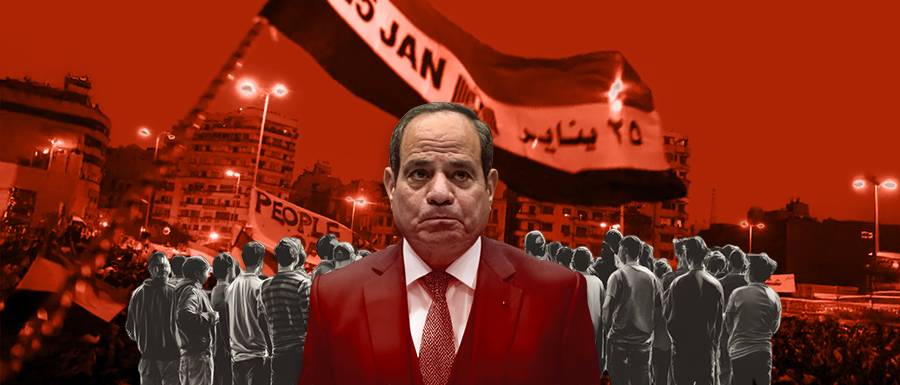
On the 15th anniversary of the January Revolution, President Abdel Fattah el-Sisi continues, with remarkable persistence, to justify the past and invoke behind-the-scenes events of 2011 and 2013, as if political time has not moved a single step forward. In his recent speech on Police Day, Jan. 25, he again denied any responsibility for killings or other violations, asserting that the Muslim Brotherhood initiated armed confrontation with the state while holding the January Revolution itself responsible for the subsequent “chaos” and “ruin.” Fifteen years later, the revolution has shifted from a founding moment in Egypt’s collective consciousness to a permanent defendant in the regime’s discourse.
This raises a fundamental question: Why does President Sisi continue to defend himself with such intensity, despite the passage of time and the consolidation of his power?
What is striking about this sustained insistence on self-defense — more than a decade and a half since the January Revolution — is not the content of the narrative, but its significance. A state confident in its legitimacy does not require this level of public exoneration, nor does it need to relitigate the revolution in nearly every official speech. The intensity of this defense suggests a lingering anxiety that January remains alive in public memory and an awareness that the struggle over its meaning remains unresolved. Consequently, Sisi’s rhetoric appears less a response to adversaries than a perpetual attempt to close a historical file that resists erasure or final condemnation.
Since assuming power in June 2014, Sisi has gradually transformed political authority into a form of total authoritarianism that governs every aspect of Egyptians’ lives — their actions, speech, and even in both public and virtual self-presentation. This transformation is reflected in his frequent speeches, the codification of repressive legislation and other authoritarian practices.
Yet, Sisi has not merely consolidated authoritarian rule; he has reduced politics itself to his persona. He has “personalized” authoritarianism, as described by scholar Erica Frantz, transitioning from a president who once sought to appease the public with promises to a leader largely indifferent to public opinion. This evolution has culminated in his repeated claims to “prophetic wisdom,” including his frequent invocation of the Quranic verse, “Then We gave Soliman the right understanding.”
This personalization is evident in his hostility toward opponents he encountered personally or those who spoke publicly about him when he served as head of military intelligence or minister of defense. Sisi has repeatedly referenced his meetings with Muslim Brotherhood officials, most notably leader Khairat el-Shater, even dramatizing one meeting in a scene in the TV series Al-Ikhtiyar 3 (The Choice 3).
The series stands as a clear example of the Egyptian state’s effort to rewrite recent history through an officially sanctioned narrative that absolves Sisi of responsibility for the military coup and subsequent repression. The production relied on archival footage accessible only to Egypt’s security services, and it portrayed Sisi himself as a central character — indications of high-level state supervision.
In the series—as well as through Sisi’s continuous and unceasing public statements—a narrative structure emerges that transforms a political meeting into a moment of moral foundation. The repeated invocation of a specific incident, with its dialogic details, and its retelling in public speeches years later, does not appear as a mere act of recollection, but rather as an effort to solidify the self in the role of the protector who confronted an existential threat to the state. In this way, political time is rearranged so that a private moment of confrontation becomes evidence of the correctness of a public decision, while historical complexity is condensed into a binary scene: one man threatens, and another stands in defense. This technique relies on the personalization of conflict, turning it into a moral drama in which legitimacy is constructed through self-testimony.
More importantly, this narrative is presented in the absence of the other party, rendering the account monologic and closed to alternative interpretations. When the adversary is excluded from the public sphere, the story is transformed into a document of proof that resists revision. Here, the defense of a political decision ceases to be a contextual justification and instead becomes a continuous reproduction of a foundational myth: the state stood on the brink of collapse, the decision was inevitable, and the leader had no alternative.
In this sense, the incident is not retold merely to clarify the past, but to secure the present, by reinforcing a fixed equation that reduces politics to two choices: chaos or salvation
Sisi also pursued direct retribution against politicians Essam Sultan and Abdel Moneim Aboul Fotouh. After the coup, Sultan said: “Now we have a leader of a military coup and a leader of the counter-revolution named Abdel Fattah el-Sisi.” As for Aboul Fotouh, who had intended to run for president, he criticized Sisi’s governance, security repression and political suffocation in a televised Al Jazeera interview. He was arrested immediately upon returning to Egypt from London and subsequently sentenced to 15 years in prison.
Another defining feature of Sisi’s personalized rule is persistent “self-defense” — a deeply psychological trait. Nearly every year, he repeats claims of innocence regarding documented crimes of repression, including mass killings, arrests, enforced disappearances and torture. In recent weeks alone, Sisi has twice said his hands were “not stained with blood,” that he has not taken money from anyone and that God alone will judge him for his rule. Much of his rhetoric remains anchored in the past, condemning the January Revolution and “the people of evil,” while glorifying himself as the savior who rescued Egypt from ruin, terrorism and other conspiracies he fabricates and repeats.
Sisi appears driven by what can be described as a psychological guilt complex, manifested in continual self-justification and defensive repetition, even in the absence of public demands for explanation, as his deeply autocratic rule has eliminated meaningful public accountability. Whether rooted in denial or genuine belief, he presents repression as a necessary act of salvation.
He repeatedly asserts that God alone is aware of his intentions and deeds and will hold him accountable on the Day of Judgment. Egyptians, in this framing, are left only “to hear and obey,” while Sisi casts himself as a divinely chosen leader who saved the nation and its people from devastation. The persistence of this narrative underscores the very reality it seeks to deny: a past whose truths cannot be permanently silenced.