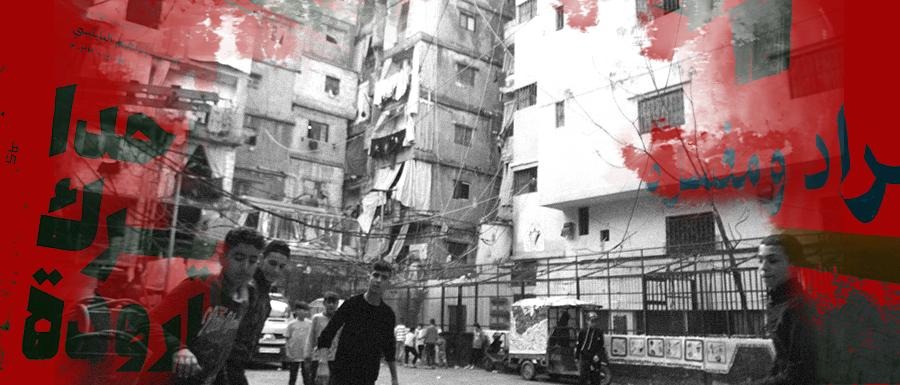
What is the fate of the half a million refugees in Lebanon living in refugee camps? A community who already endures a life of poverty and extreme challenges for more than 70 years. This brings me back to my experience visiting the Shatila refugee camp.
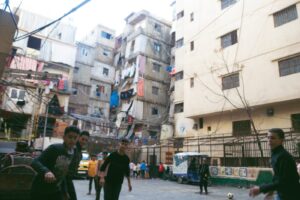
The scars and nightmares left by the loss of their homes in 1948 and the Shatila massacre in the 16-18 of September 1982 have been reopened once again –by the war in Gaza, and by the bombardment of Beirut. Across Lebanon, every Palestinian is on high alert, bracing for what seems inevitable: a deadly attack inside the overcrowded refugee camps. Such an attack would kill thousands of refugees in a matter of minutes.
Last December, I visited one of the most densely populated areas in the world, the Shatila refugee camp located in southern Beirut, Lebanon, where forty thousand refugees are crushed into living in one square kilometer.
The camp was originally established for the Palestinian refugees who were expelled during the 1948 Nakba. The site later became infamous for the horrific 1982 massacre, when the Lebanese Phalangist militia, supported by the Israeli army, killed thousands of Palestinians.
I had never seen such a drastic change of scenery in 15 minutes. Driving from the upper-class neighborhood of Achrafieh to the entrance of the Shatila refugee camp, I felt like I was stepping into a different world.
There at the entrance, I met with Majdi, as referred to by the camp’s inhabitants as Coach Majdi who I had been in talks with before my trip to Lebanon to accompany me during my visit.
He led me on a walk through the camp, and from the outset of our trek, it was clear that Shatila suffers from a broad set of dire issues.
In many refugee camps like Shatila, the use of permanent construction materials, such as reinforced concrete, is often restricted or prohibited by the Lebanese government. This leads to the use of non-standard, and non-Proper waterproofing materials such as concrete blocks, and sheet metal. The use of these materials causes acute respiratory issues among the residents due to mold exposure.
People here can’t feel direct sunlight on their skin unless they leave the camp, these buildings are too close to each other, and the alleyways are too narrow. People have major lung problems and vitamin D deficiency,
Majdi said, as we walked through the camp streets.
Walking through the loud sound of news channels coming out of every window, and between the hundreds of banners of various political parties and the pictures of martyrs and leaders, decorating the alleys of Shatila an excessive number of hanging cables—suspended very dangerously low. These dangling wires often become tangled, making their maintenance even more challenging. He said that when it rains, people get electrocuted and some die, they become what they call “electricity martyrs”.
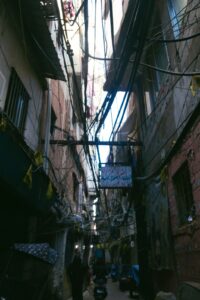
Walking deeper into the camp’s labyrinth I couldn’t but notice the piles and piles of garbage on the sides, as he explained “At Shatila even something as simple as not having months old garbage is seen as privilege”.
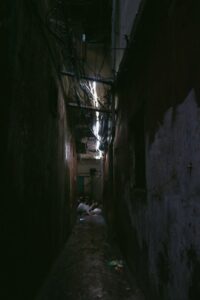
UNRWA is responsible for providing services such as healthcare, education, and sanitation. However, due to the funding cuts, the number of sanitation workers has remained unchanged for some time, even though the number of residents has grown, resulting in a decrease in garbage collection frequency. This contributed to the rapid build-up of waste, the chronic infestation of rats, and diseases.
We arrived at his home, a three-story unfinished house exposed with raw cement bricks. He and his family live on the first floor, while his youth club occupies the other two.
Having first launched a boys’ football club under the name Palestine Youth in 2009, Majdi has since expanded it to two teams. And established a basketball team dedicated solely for girls—Palestinians, Syrians, and others from the refugee.
“Basket Beats Borders” The Shatila refugee camp’s all-girl basketball team has a mission that extends outside sports. Not only does the team provide a haven for young women in their teens and early twenties to enjoy sports and express themselves, but the players are also gradually establishing projects that support their larger community. The initiative offers them a chance to develop a healthy and positive lifestyle and integrate into society through sports. Thankfully with the help of international NGOs and other international sports teams, the girls’ basketball team, and the football club players sometimes get invited to play outside the borders. “These kids are in desperate need of something that unites them and brings them joy, something they can identify themselves to with other kids outside the camps” He asserted.
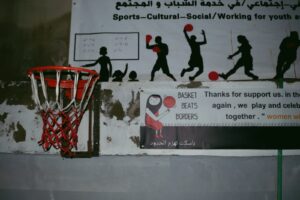
Only through international intermediates, fundraisings, and donations can they cover travel expenses, and leave the country, as legally they are considered stateless residents in Lebanon with no equal rights to Lebanese people, so visas and paperwork are hard to get. In addition to that are the financial restrictions due to legal discrimination and the limited job opportunities; The Lebanese government prohibits Palestinians from 70 different professions in medical, legal, engineering, and teaching sectors, forcing Palestinians to rely on informal jobs that offer little benefits, and security.
Coach Majdi wanted us to start with the third floor, where they usually play basketball or football, however, during the rainy season it is impossible since the metal sheet roof leaks water that covers the entire cracked floor. He then pointed to the sagging spot on the floor and said “Without money or help I won’t be able to fix this hazard! It’s too dangerous”. Then we made our way to the second floor where his office and his little community center are. Embellished proudly with kid’s drawings, and sports medals, trophies they have won in Lebanon, Jordan, Spain, and Italy. And right in the corner, there is a whiteboard for whenever volunteers come to teach young kids languages. Sometimes it’s a complete foreigner, and other times it’s a Palestinian living abroad and wants to give back.
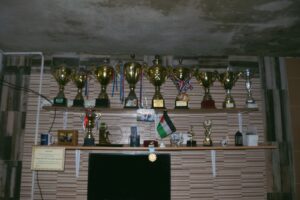
Coming down to the first floor I met with his son, daughter, and grandson who without hesitation gifted me a pin with a Palestinian flag. which made me feel honored. His 20-year-old son dropped out of high school as he explained that he thought there was no purpose to continue. His abandoned dream was to be a photographer, and when asked about it, “That’s too much of a luxury” he replied. His daughter who is a mother to a 7-year-old boy is 23 years old. “I wanted to be a nurse, but it wasn’t a profession I was allowed to study, so I had to go to an expensive private school. After my first year I stopped, because I didn’t have that much money to finish my studies”. She explained while playing with her son.
They pointed out that the 2001 Law No. 296, highlights the government’s pursuit to limit the rights of refugees in Lebanon— restricting them from various professions, and prohibits families from owning properties. They told me the stories of many Palestinians who tried to own a house through a Lebanese third party, usually a friend, or someone they know, but ended up being tricked and forcefully kicked out as legally it wasn’t theirs even though they paid for it.
Later that day his son Yussif, took me on another walk through the camp introducing me to his friends and showing me small businesses that the entire population relies on. From the clothing repair store that fixes everyone’s clothes to the bakery that relies on UNRWA’s aid. Everyone was watching Gaza very closely.
One guy said,
Israel could use the same tactics to justify an attack on Lebanon and attack Palestinians who live here, thousands will die, and then where do we go? We are cornered, and the only way out is to fight back.
He and his friends told me that the camp faces a drug abuse problem among young people due to a lack of governance, and how little it costs to buy them. Drug traffickers thrive in places like Shatila as it lies outside the jurisdiction of the Lebanese state, leaving the armed factions controlling the area, which themselves allow these illegal activities for money gains—adding to the fact that young people here have little to no hope, and are easily manipulated to use, and sell substances. They said that drugs are cheaper here than in Beirut or elsewhere in the Middle East. From coke to Captagon, to heroin, even pills that typically require prescriptions are legally sold in camp pharmacies to residents without prescriptions like Tramadol and Xanax.
For years a coalition of NGOs and organizations including UNHCR, and Caritas Lebanon has addressed this drug abuse issue in the camp. These initiatives focus on prevention, and rehabilitation through counseling services and awareness campaigns within the community, also addressing the stigma, and the aggressive policing that only discourages healthcare seekers. Yet despite the efforts to combat drug abuse, these initiatives struggle to make significant progress due to chronic underfunding, and tight financial resources hindering the ability to implement and maintain sustainable programs. Nor do these efforts fix the root problem of drug trafficking through the Syrian borders, or the corruption that leads these drugs undetectable through Lebanon to the camp.
Our last stop was a glimpse at the endeavor to preserve the Palestinian heritage and history. Buried within the web of dark alleyways of Shatila you find the Memories Museum. An initiative of one of the camp’s residents Mohammed Khatib, aimed at documenting and preserving Palestinian identity. The museum’s single room is a silent witness to the history of occupied Palestine before the Nakba 1948 and 1967 exodus. Housing around a thousand artifacts ranging from old Palestinian pound coins to metal agricultural tools, simple antique lamps that once lit Palestinian village homes, to keys to places that no longer exist. “Every piece has a story,” as it is written on the museum’s outer door. These stories narrate the history, customs, and traditions of a people who still dream of returning to Palestine one day. In a conversation, the founder of the Museum said, “I established this museum in 2005 to respond and affirm to the Israeli enemy that Palestine has a people and a civilization, and to fight the claims that it was a ‘land without a people’.”
The painful memories have inspired him to devote his entire time to combating the forced erasure of Palestinian heritage.
Along with his brother, Mohammed Khatib has been operating the museum, building the collection with both donated and purchased items. He spent years collecting them from families living in refugee camps in Lebanon, Syria, and Jordan.
He gestured with his hand to a case made of glass on the wall, an old, rusty axe, and said that it’s one of the very few items recovered from the 1982 Sabra & Shatila massacre. He was also among those who survived it, unlike the other 3,000 Palestinians who were killed.
Unfortunately, through the years he has encountered major issues, hundreds of items have been damaged due to poor storage conditions, lack of sunlight, and high humidity in the area. When asked about the availability of experts to manage and safeguard these tools, he expressed frustration “No one really cares about the situation. We’ve made numerous appeals without any response, and at this point, I’m afraid we’ve started to lose hope.”