
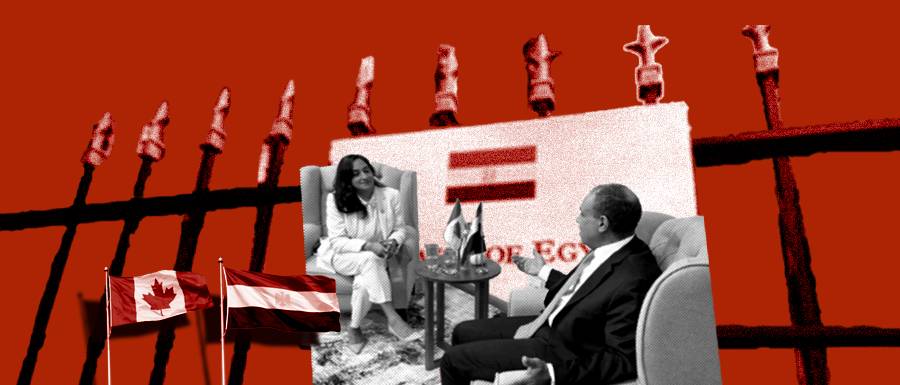
On November 23, 2025, Canada’s Minister of Foreign Affairs, Anita Anand, met with Egypt’s Foreign Minister, Badr Abdelatty, in South Africa during the G20 Summit.
Anand said on X platform that Egypt and Canada share strong interests in promoting peace and security in the Middle East. She reaffirmed Canada’s commitment to working with allies, including Egypt. Meanwhile, the Egyptian Foreign Ministry’s statement highlighted Egypt’s desire to strengthen economic and trade relations between the two countries and to encourage Canadian companies to invest in Egypt, particularly in the energy, agriculture, and water resources sectors. It also praised Canada’s recognition of the State of Palestine last September, and the minister reviewed recent developments in Gaza.
While Anand focused on promoting peace and security in the Middle East, the Egyptian foreign minister focused on strengthening economic and trade relations between the two countries. Each official presents their government’s foreign policy priorities, but is it truly beneficial for Canada to consider Egypt a partner in achieving security and peace in the Middle East? And does the pursuit come at the cost of overlooking Egypt’s poor human rights record and Canada’s engagement with Egypt’s military regime?
Egypt has been suffering from a severe economic crisis for years. The country’s shortage of foreign currency and the sharp depreciation of the local currency against the U.S. dollar have strained the economy. Thus, it is unsurprising that the Egyptian government is currently seeking to boost foreign investment, especially as external debt reached 44.5 per cent of gross domestic product (GDP), totaling USD 161.2 billion, by the end of March 2025.
Yet, instead of adopting genuine reforms to promote internal security, stability and encourage investors to enter the Egyptian market, the Egyptian government has chosen a security-driven approach since the July 2013 military coup. Authorities have seized the assets of businesspeople, abused counterterrorism laws, pressured private-sector figures into forced partnerships with state-owned enterprises, and compelled them to buy failing state companies at inflated prices. They have also repeatedly demanded large donations to sovereign funds—practices that human rights organizations documented between 2017 and 2024.
When it comes to regional security and peace, can such matters be meaningfully discussed with a foreign minister whose government incites against its own citizens abroad and practices transnational repression targeting activists, journalists, and human rights defenders in exile?
Last September, 20 human rights organizations condemned what they described as “an unprecedented weaponization of Egyptian diplomatic missions as tools of transnational repression against peaceful protesters abroad.” An audio recording was leaked of Foreign Minister Badr Abdelatty instructing embassy staff overseas to assault peaceful pro-Palestine demonstrators calling for the opening of the Rafah crossing to allow humanitarian aid into Gaza.
Abdelatty said: “grab them [protestors], tie them up, drag them inside, and make their lives hell.”
These instructions translated into real-world assaults by embassy personnel in several countries, including New York in the United States, where security staff dragged American citizens, one of them a minor, into the mission building and beat them. In The Hague and London, diplomatic missions mobilized government loyalists to gather in front of embassies to intimidate and threaten protesters.
At the same time, Egyptian security forces inside the country targeted the families of exiled activists and journalists. Organizations documented at least one case where a family member of an exiled journalist was detained and forcibly disappeared in retaliation for the journalist’s work.
These abuses have not been limited to Egyptians; several Canadian citizens have also been affected since current President Abdel Fattah el-Sisi came to power. Last June, more than 40 Canadians participating in the Global March to Gaza were detained in Egypt.
In 2020, Canadian citizen Yasser Al-Baz, who had been detained in Egypt for nearly 500 days, was released following direct intervention by former Prime Minister Justin Trudeau.
In 2014, The Globe and Mail reported on the arrest of Canadian journalist Mohamed Fahmy in Egypt, where he was held for 100 days, “In Egypt, interviewing opposition activists or merely possessing a video camera and editing software can land you in prison. These are the central pieces of evidence prosecutors in Cairo have used to saddle the Canadian-Egyptian journalist Mohamed Fahmy and his codefendants with terrorism charges and a possible 15-year prison sentence.”
Another case involved Canadian filmmaker John Greyson and Canadian doctor Tarek Loubani, who were arrested in August 2013, spent nearly 50 days in detention, and were investigated for alleged crimes including murder, incitement to murder, terrorism, attacking a police station, and using explosives against it.
Canada places great importance on human rights values when shaping its diplomatic relations. Promoting and protecting human rights is central to Canada’s foreign engagement, and the country is committed to defending human rights, inclusive and accountable governance. Canada also operates a dedicated program to resettle at-risk human rights defenders in exile.
Therefore, it is unacceptable in any form to overlook Egypt’s human rights abuses when engaging with its government. The human rights situation must be raised in every meeting or discussion that treats Egypt as an allied state or addresses shared interests in promoting “security and peace” in the Middle East, or considers expanding economic and trade relations.
More importantly, Egypt’s poor human rights record should be addressed explicitly, and any deepening of trade ties should be linked to clear, measurable commitments to improving human rights inside Egypt.