
Research Focus, Methodology, and Questions:
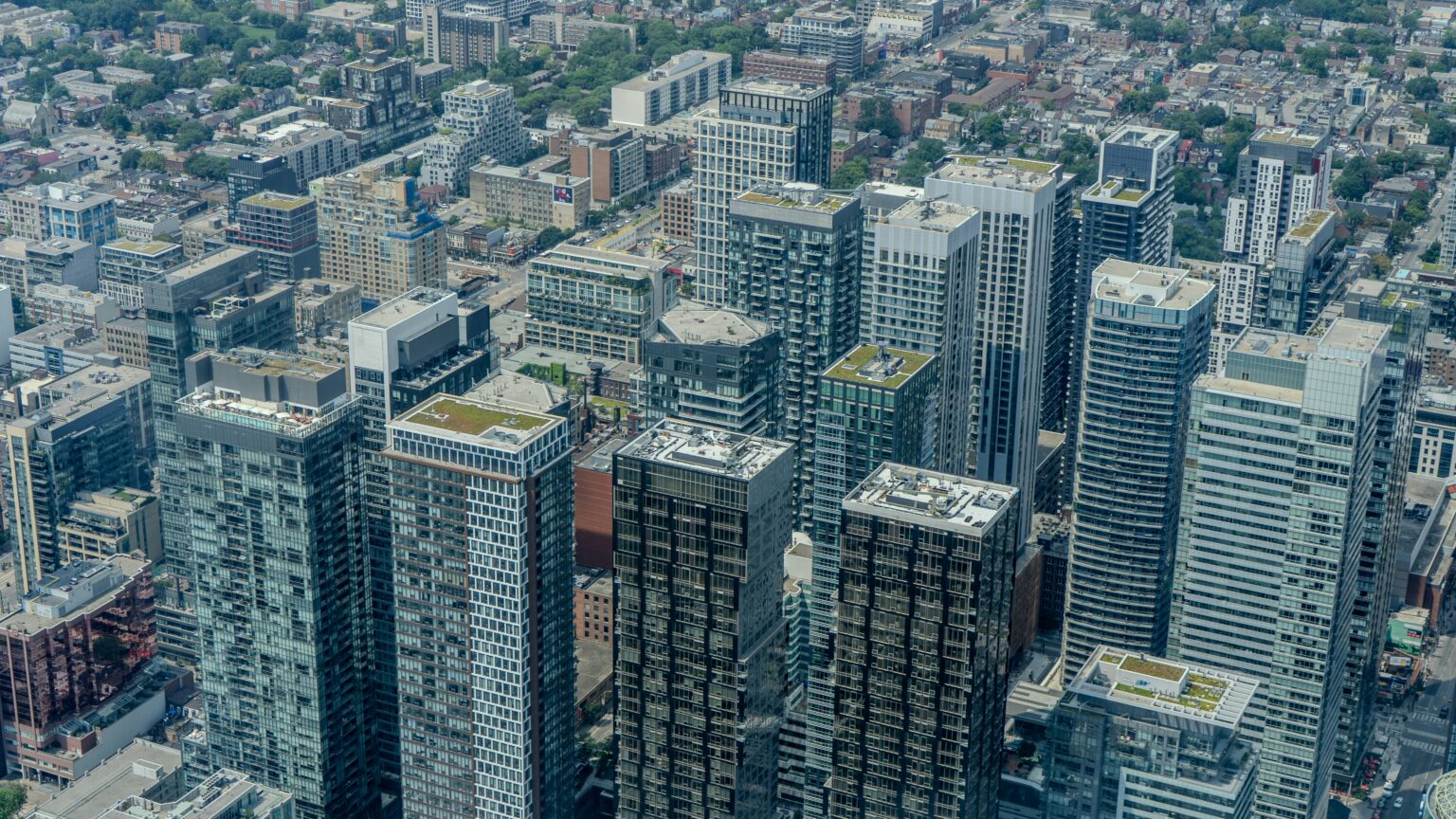
The research focuses on the rapid urban change that has occurred in the City of Toronto, with an emphasis on the midtown area, specifically from Yonge–St. Clair north to Yonge–Eglinton, passing through Davisville. Over the last decade, Toronto has undergone major urban transformation, with an increasing turn toward vertical intensification that has become the primary driver across large parts of downtown and midtown, shifting from low-rise and mid-rise houses to tall residential towers. The research concentrates on the Davisville area between St. Clair and Eglinton, exploring how this transformation reached the neighbourhood; how it affected public space, community services, and small local businesses; the noticeable change in neighbourhood character and heritage buildings; and its effect on the rising cost of living.
The research methodology relied on interviews with small business owners in Davisville and affected residents, as well as an interview with Sebastien Gibson, a senior advisor to Councillor Josh Matlow, in addition to open-source information from the City of Toronto’s online portal and prior research.
Key research questions:
How does vertical urban intensification affect the city’s heritage fabric and the character of Toronto’s neighbourhoods? How do high-rise buildings influence public space, access to community services, and affordability, along with the pressure placed on city infrastructure? How do Davisville residents view this expansion into their area, and what role does the City of Toronto play in preserving heritage buildings, maintaining neighbourhood character, and ensuring access to services at reasonable prices?
Background:
The Imperial Pub was closed on November 15, 2025, after 81 years of operation in downtown Toronto, due to a major redevelopment project in the area (Global News). It is not only the Imperial that is shutting down; a number of small local businesses in midtown are also closing.
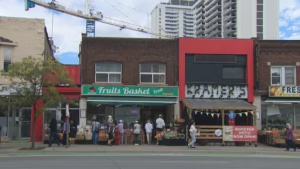
After 34 years in business, a Pizza Pizza franchise in Toronto’s Davisville neighbourhood has closed its doors, joining a growing list of local small businesses in the area, including a dollar store, two produce grocers, and several bars, that have recently shut down because of a major development project to construct high-rise condos.
On July 2, 2025, Davisville’s residents learned about the demolition of the two-storey mixed-use building, when the City of Toronto published a notice of residential demolition at 1951 Yonge St. under the authority of the Municipal Code.
This block, located across the street from the Davisville subway station, served as a central hub for residents, offering affordable food sources. In early September, residents began to feel the impact following the closure of Kramer’s bar, Pizza Pizza, and two produce grocers (Fresh Buy and Fruits Basket). Just one month later, a dollar store operated by a Ukrainian family also closed its doors.
Why Toronto Keep Building Condos No One Can Live In?
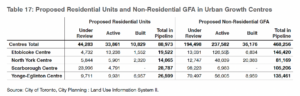
In a report issued by the City of Toronto in 2023, City of Toronto Development Pipeline 2023, it was noted that the Yonge–Eglinton Centre contains the majority of residential units built over the five years preceding the study. The report examined how Toronto has developed and continued to grow over time and offered an overview of all development projects that had received approval or had construction activity between January 1, 2019, and December 31, 2023 (Document 01).
The study showed that the Yonge–Eglinton area was the hub of urban growth during that period and contained most of the residential units that were built. There was also a large expansion in non-residential units, the majority of which were likewise concentrated in the area.
What is striking in the city’s available data is that the total proposed residential units, whether completed, active, or under review, number 26,599, while there are 113,561 proposed non-residential units. This means residential projects account for only about 17% of total development in that area, compared with non-residential projects.
Another study published in June 2017 about development in Toronto around the Yonge–Eglinton area, including Mount Pleasant, concluded that vertical expansion in the area caused four key issues: (Document 02)
- Fundamentally changes the character of the neighbourhood
- Impacts the amount of sunlight on the public realm
- Enables two towers on deep lots which limits skyview
- Loss of spaciousness and building variability
Another major issue with the spread of modern residential unit typologies in high-rise buildings, which typically reduce unit sizes to maximize the developers’ revenue, is the failure to consider people’s needs and the unsuitability of cramped spaces for families and children.
The City of Toronto addressed this problem in its Urban Design Guidelines 2020: Planning for Children in New Vertical Communities. (Document 04)
The guidelines indicated that between 2006 and 2016, more than 143,000 new housing units were built in Toronto, 80% of them in buildings over five storeys. At the same time, the number of families with children making their homes in these buildings has been increasing.
In 2016, the number of families with children and youth in high-rise buildings had grown by 15,000 compared with 1996. The guidelines predicted that as the population increases, long-term demand for family-appropriate housing will exceed the expected supply if current trends continue. This mismatch between supply and demand is exacerbated by a shortage of larger units and a trend toward smaller ones. The City and its development partners will need to work together to provide suitable housing options for larger families.
The purpose of these guidelines, produced after a two-year study and followed by a two-year implementation and monitoring period, was to focus on how to develop new mid-rise and high-rise buildings as vertical communities that support social interaction and better meet the needs of all families, including those with children.
In the final recommendations report sent to the Planning and Housing Committee on June 25, 2020, the Chief Planner and Executive Director of City Planning noted that Toronto is experiencing an increasing shift toward vertical cities, with 94% of new housing units located in mid- and high-rise buildings (Document 03).
A single high-rise today may contain more residential units and a higher population than some of the divisions and neighbourhoods that formed Toronto in the 19th and 20th centuries. Planning for these buildings must be carefully considered in terms of how they function as vertical communities to support housing diversity and contribute to Toronto’s long-term liveability.
In this context, has the City of Toronto worked over the past years to reduce the problem and take into account the recommendations mentioned in the report, or has the provincial government given greater power to investors and real estate developers? Has the problem diminished or continued to grow?
Returning to Davisville, and the closure of a number of small shops due to redevelopment projects, the main concern among residents was the loss of accessible services without nearby alternatives. Chris Chan wrote in a Davisville community Facebook group: “This isn’t fair; I don’t want to buy expensive produce.”
Shorouk Mohamed, a human rights researcher and Davisville resident, says she was heavily affected by the closure of small shops to make way for new high-rise towers, as these stores were part of her daily routine, buying daily essentials like fresh vegetables or grabbing a morning coffee nearby at “minimal cost and effort.”
“Now, after they all closed, I have to walk long distances and use public transit just to carry out the simplest daily tasks that I used to do easily,” She said.
After the closures, Mohamed began turning to alternatives such as bigger stores or online delivery apps. The experience was entirely different: prices were higher, stores were farther, and she noticed that some products previously available in small shops were no longer sold in the larger stores, such as specific local brands or certain types of fresh produce that neighbourhood shops consistently carried.
She now has to search extensively and move between multiple stores to find substitutes, which are often more expensive and of lower quality. Organizing her weekly needs as she once did now requires a great deal of time and effort. This makes her feel she has lost part of “the simplicity of her daily routine,” the sense of ease those small shops provided.
Mohamed says she understands that condos are part of urban development plans and that the goal is often to provide housing for more people, especially in big cities. The issue is not development itself but how it is implemented.
She believes that although high-rise buildings and condos may look attractive from the outside, they suffocate the spirit of place. Nature disappears, green spaces shrink, and the neighbourhood turns into massive concrete blocks—spaces devoid of life. Low-rise buildings have greater architectural charm and create harmony between neighbourhood character and the natural environment. They preserve sunlight and open spaces, allowing people to feel they truly live, not that they are trapped between towers.
“Real development is that which balances progress with preserving a community’s identity, spirit, and environment.”
Lamia Zrik, a Syrian-Canadian resident of Davisville, says the small fruit shops that closed reminded her of home. She couldn’t enter her house without stopping by first. Zreik was very saddened when the shops shut down and didn’t know where else to buy. She felt as if the entire area had lost its charm. Those shops served the neighbourhood well, especially given its dense population.
She adds that she no longer knows where to shop. Large stores are expensive, and she feels no “emotional connection” to them as she did with the small local shops.
She says angrily:
“Why build such tall buildings? Leave us some comfortable spaces. Places where we can see the sky and feel the air. Downtown and Eglinton are full of condos… leave Davisville for us.”
Sebastien Gibson, a senior advisor to Councillor Josh Matlow, said the two produce grocers have been supported by Councillor Matlow’s office to find new space in the neighbourhood. According to Gibson, both businesses are currently in lease negotiations with nearby property owners, and it appears that both will be able to return to the neighbourhood soon.
He said that small businesses are under threat and there should be some form of rent-control protection to shield them from very large increases by developers who are simply trying to push them out.
There is another concern about preserving heritage buildings, since this block includes properties listed on the Toronto Heritage Register.
The Circles and Squares Bakery in this complex is designated as a heritage property and will not be demolished, Gibson said. However, he believes the city lacks sufficient authority to protect heritage properties. He said the Ford government has intentionally weakened the city’s ability to protect vital heritage resources because much of its policy is written by the development industry. “We need stronger heritage protections,” he said.
Urban researcher Ibrahim Ezz El-Din says:
The push for high-rise towers and transforming cities into skylines of skyscrapers often comes at the expense of residents, heritage, or even the city’s present character. It is a major problem commonly categorized as “urban globalization”—that is, the drive toward modernization.
Today, the world is moving toward urbanization, building new cities and erecting towers and skyscrapers. But this process heavily affects, and often sweeps away, everything below the upper-middle class: those who have no place in bourgeois spaces. It also erases heritage sites. Development almost always comes at the expense of the most vulnerable and marginalized groups and, increasingly, at the expense of historic and cultural places.
Sebastien Gibson said our main streets are being destroyed by redevelopment, leaving us with essentially soulless glass condos, dentist offices, Shoppers, and big grocery stores.
“We don’t have the ability within the Planning Act, legally, to prescribe how large the floor plate of a retail unit can be in the zoning bylaw. So you have to push developers to get them to agree—and some are more flexible, others less. So there are cases where we’re fighting to secure more small-scale retail replacement despite not really having the power to do it; we’re leveraging all the tools we have available.”
According to data from the Municipal Property Assessment Corporation (MPAC), in 2022, condos in Ontario were on average 35% smaller than they were 25 years earlier, with size reductions reaching 45% in some areas such as Markham.
In the mid-1990s, the average size of a condo in Ontario peaked at around 1,100 square feet. MPAC’s latest data show that the average condo today is about 700 square feet.
The sizes have continued to decline: according to new MPAC figures, in 2024 some of the smallest condo units in the Greater Toronto Area (GTA) were built in Toronto, where the average size for condos built since 2020 is only about 616 square feet.
And while the average size of newly built condos in Toronto is 616 square feet, MPAC notes that there are thousands of micro studio units in the city, often under 500 square feet.
For all these reasons and problems, it was expected that the situation would blow up and condo investments would collapse—which is exactly what happened, wrote Ali Amad in Maclean’s:
“For years, low interest rates fuelled a big-city condo-flipping frenzy. Profits got bigger and condos got smaller. Now the bubble has popped, leaving behind thousands of unsellable, unlivable units.”
Amad analyzes the current situation, noting:
The collapse of the condo market, and the failure of policymakers to rein it in, will have consequences that reach far beyond investors in free fall. Between 2011 and 2021, condos comprised 89 per cent of total apartment completions and 54 per cent of total new rental supply in the Greater Toronto Area. In some big cities, or at least in their urban cores, new housing became almost synonymous with condos, even as the units were used as investment vehicles: small, one- or no-bedroom units unsuitable to the needs of the country’s population.
As a result, the long-term consequences go beyond affordability; they shape who gets to build a life in the country’s biggest cities. Research from the Missing Middle Initiative, a group of housing policy researchers at the University of Ottawa, shows a strong correlation between the growth of ownership-based homes with three or more bedrooms and the population growth of young children. And by sidelining families, policymakers have also jeopardized a key pillar of Canadian financial security: the ability to build equity and retirement savings through homeownership.
Buyers aren’t only holding back due to mediocre or undersized units. Even the reduced prices developers are now advertising remain out of reach for many. So sales continue to fall: this past June, the Canada Mortgage and Housing Corporation indicated that condo sales in Toronto and Vancouver were down 75 per cent and 37 per cent, respectively, between 2022 and the first quarter of 2025.
The decline affects both completed units and pre-sales and the latter is especially ominous, since developers need them to finance new projects. From January to June of 2025, housing starts were down 44 per cent in the Toronto metro area, and 11 per cent in Vancouver’s, compared with the same period in 2024.
As for Kathy Chow in The Walrus, she wrote an article aptly capturing the current crisis:
“No One Wants to Buy a Condo” — Canadians piled into real estate investment. Now their units are worth less than their mortgages.
She asks in her piece: This has always been the conventional wisdom: it’s never a bad idea to buy property if you are able. So what changed?
Chow answers:
The simple answer is that many condos built between the late 2010s and early 2020s were constructed not for living but for investment. Since 2000, there has been a steady increase in the proportion of condos used as investment properties. To my surprise, most of the investors were not faceless corporations or foreign investors. Research by Statistics Canada shows that the typical condo owner is a middle-aged, middle-class Canadian couple. The reigning logic for the middle class was that buying a condo, renting it out to pay for the mortgage, and eventually selling the unit was a solid way to make money. This was especially true in the late 2010s, a period of low interest rates and weak rent-control policies. Steady demand for housing, partially caused by increasing immigration, made real estate seem like a sure bet.
Developers knew that most pre-construction buyers were investors rather than people looking to live in the apartments themselves. As a result, they focused on quantity over quality. Vishakh Alex, an architectural designer working in Toronto, said that the directive from developers in the late 2010s was to squeeze in as many units as possible.
Developers also sought to cut costs where they could. For example, many of the buildings from around that time were constructed with glass, which is terribly energy-inefficient but cheaper than materials that provide better insulation, like precast concrete. The cost is punted downstream to the residents, who end up saddled with exorbitant utility fees to cool the units in the summer and heat them in the winter.
The upshot of all this is that mom-and-pop investors have increasingly struggled to find buyers. In addition to the small size and shoddy quality of the condos, sellers have also had to contend with high interest rates over the past two years, which has made consumers more cautious. Meanwhile, stagnant wages and the rising cost of living have reached a tipping point, locking potential buyers out of the process and leaving more units on the market. The combination of reduced demand and excess supply has led condo prices to plummet.
From these points, we can draw some conclusions: the crisis of condos and high-rise buildings is not new or sudden—it is the result of accumulated weak policies, jurisdictional conflicts between municipalities and provincial governments, and years of investor and developer greed. The crisis is not limited to Toronto; it extends across Canada, concentrated in major cities such as Toronto and Vancouver.
What is puzzling is why the province continues to grant building permits to developers in Toronto—at the expense of heritage buildings, neighbourhood character, small business owners, and the places that have shaped the city over decades—as seen in the approval to demolish the Imperial Pub downtown, and in demolition permits in the Yonge–Eglinton and Davisville areas for new real-estate development.
What, then, motivates developers to keep moving forward with these projects despite the collapse of the condo market, significant price declines, and waning buyer interest?
Perhaps Toronto needs, more than ever, bold policies and legal protections to shield the city from fragmentation, the destruction of its historical traces, and the complete erasure of its character and diversity in the face of the tsunami of high-rise towers and condo boxes.
Bibliography:
- Amad, Ali. “Canada’s Condo Market Is Crashing.” Maclean’s, 18 August, 2025, https://macleans.ca/longforms/canada-condo-market-crash/
- Chow, Kathy. “No One Wants to Buy a Condo.” The Walrus, 3 September 2025, https://thewalrus.ca/no-one-wants-to-buy-a-condo/
- City of Toronto. City of Toronto Development Pipeline 2023. City of Toronto, 31 December 2023. Document 01.
- City of Toronto. Final Recommendation Report: Growing Up—Planning for Children in New Vertical Communities Urban Design Guidelines. City of Toronto, 25 June 2020. Document 03.
- City of Toronto. Yonge + Eglinton Built Form Study. City Planning Assesment, 3 June 2017.
- Ezz Al-Deen, Ibrahim. Personal interview, 7 October 2025, Signal App.
- Gibson, Sebastien. Personal interview, 6 October 2025, Google Meet.
- Imperial Pub to Close After 81 Years. Global News, 3 October 2025, https://globalnews.ca/news/11460283/imperial-pub-toronto-close-81-years/
- Mohamed, Shorouk. Personal interview, 7 October 2025, Signal App.
- Municipal Property Assessment Corporation (MPAC). “Condos Getting Smaller, Detached Homes Getting Bigger.” MPAC Newsroom, 19 October, 2022, https://www.mpac.ca/en/News/PressRelease/Condosgettingsmallerdetachedhomesgettingbigger0
- “From Spacious Homes to Compact Condos: MPAC Data Reveals Shifting Housing Trends Across Ontario.” Newswire, 5 December 2024, https://www.newswire.ca/news-releases/from-spacious-homes-to-compact-condos-mpac-data-reveals-shifting-housing-trends-across-ontario-880531978.html
- Pasalis, John. “Why Toronto Doesn’t Build Family-Sized Condos.” Move Smartly, 30 July 2025, https://www.movesmartly.com/articles/why-toronto-doesnt-build-family-sized-condos
- Move Smartly. “Why Canada Only Builds Micro Condos — And What We Can Do About It.” YouTube, uploaded by Move Smartly, 18 July 2025, https://www.youtube.com/watch?v=C0iE_2nMNY8
- Toronto Today Staff. “Toronto’s New Condo Units Are Now the Smallest in the GTA, MPAC Report Shows.” Toronto Today, 7 December 2024, https://www.torontotoday.ca/local/real-estate-housing/toronto-new-condo-units-smallest-gta-mpac-report-9913954
- City of Toronto, “Urban Design Guidelines 2020: Planning for Children in New Vertical Communities,” 2020. Document 04.
- Zrik, Lamiaa. Personal interview, 7 October 2025, Phone Call.